The Ultimate Workshop Organization Guide
Organize a woodworking shop with practical zones, storage systems, labeling ideas, and a step-by-step plan for reclaiming your workspace.
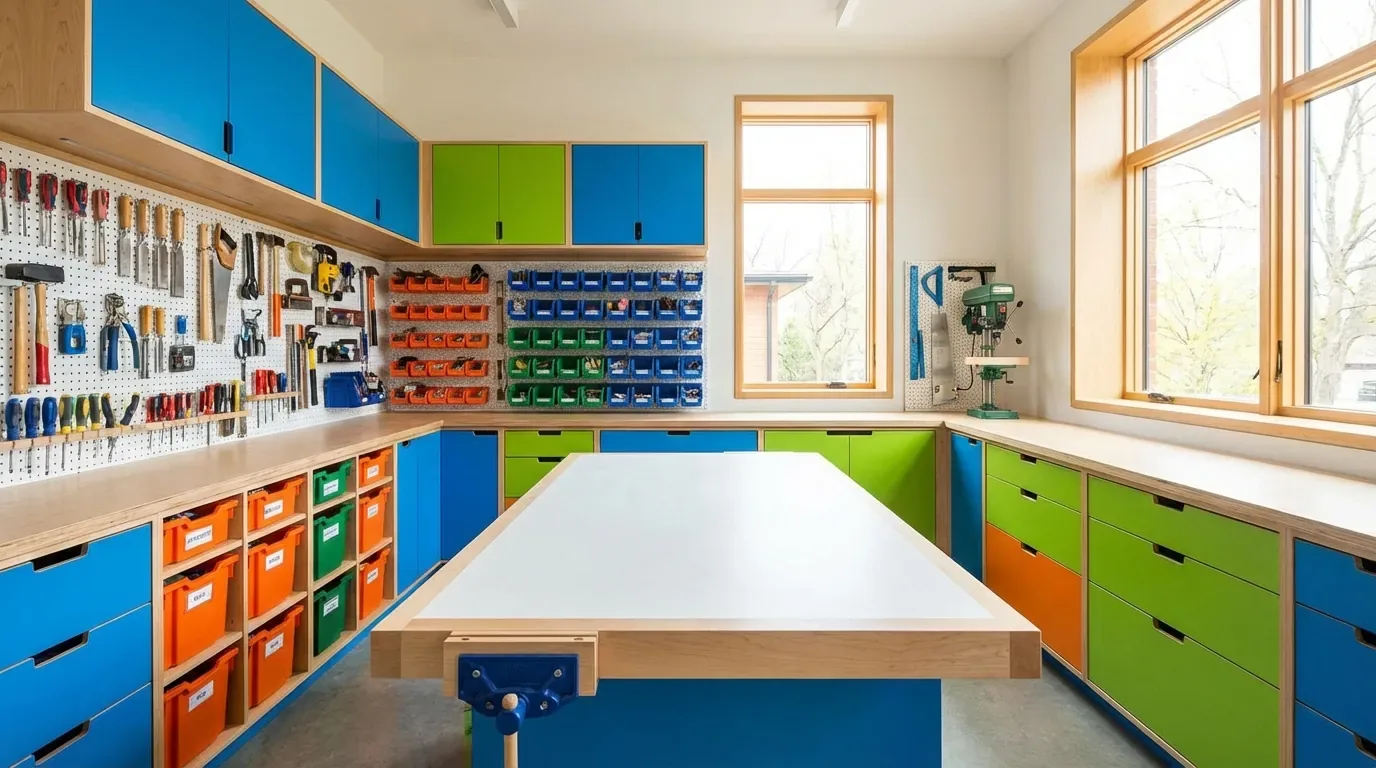
Table of Contents
- The Psychology and Logic of Workshop Organization
- Verticality: Reclaiming Your Floor Space with Wall Systems
- Small Parts, Big Headaches: Managing Hardware and Fasteners
- Mobility: Creating a Flexible Workshop Layout
- Lumber Management: From Slabs to Scrap Offcuts
- The Workbench Hub: Maximizing Your Primary Workspace
- Power and Air: Managing the Invisible Clutter
- Dust Collection Infrastructure and Workflow
- The 5S System: Maintaining Your Organized Shop
- Frequently Asked Questions
The Psychology and Logic of Workshop Organization
Workshop organization is far more than just "cleaning up." It is a fundamental component of the woodworking craft that directly impacts your safety, efficiency, and the quality of your finished projects. When a shop is disorganized, your brain is forced to process "visual noise," which leads to decision fatigue before you’ve even made your first cut. A well-organized space allows for a "flow state," where the transition between tasks—from dimensioning lumber to assembly—is seamless. By assigning a dedicated home to every tool, you eliminate the frantic search for a misplaced marking knife or a specific drill bit, keeping your momentum high and your frustration low.
The logic of a professional-grade workshop is built on the concept of "Work Zones." Most woodworkers benefit from dividing their space into four primary areas: the Rough Milling Zone (miter saw, planer, jointer), the Processing Zone (table saw, band saw), the Assembly/Workbench Zone, and the Finishing Zone. By organizing tools and storage around these specific activities, you minimize the number of steps you take across the shop. For example, keeping your squares and marking gauges near the workbench, while storing extra blades and wrenches near the table saw, ensures that the tools you need are always within arm's reach of the task at hand.
Furthermore, an organized shop is a safer shop. Tripping hazards from stray power cords, respiratory risks from unmanaged dust, and the danger of reaching over sharp blades to find a tool are all mitigated through intentional storage. When every item has a designated place, you can spot missing tools at a glance, which is a crucial habit for maintaining expensive equipment and ensuring that nothing is accidentally left inside a machine or under a pile of sawdust. Investing time in organization isn't just about aesthetics; it’s about creating an environment where you can do your best work without unnecessary risk.
The "First Order of Retrievability" Principle
The "First Order of Retrievability" is a concept popularized by shop organization experts that suggests you should never have to move one object to get to another. In a workshop context, this means avoiding deep cabinets where tools are buried behind one another. Instead, favor shallow shelving, drawers with dedicated inserts, and wall-mounted racks. When you can see and grab any tool in a single motion, your workflow accelerates significantly. This principle also applies to visibility; using clear bins or open-faced shadow boards ensures that you spend zero time wondering where a specific jig or accessory is stored.
Implementing this requires a shift in how you view storage density. While it might be tempting to pack as much as possible into a single cupboard, the "stacking" method is the enemy of efficiency. If you have to move three boxes of screws to reach your biscuit joiner, you are less likely to use that tool or, worse, less likely to put it back properly. Aim for "wide and shallow" rather than "narrow and deep." This approach not only makes tools easier to grab but also makes it immediately obvious when a tool has not been returned to its home, serving as a built-in inventory management system.
Verticality: Reclaiming Your Floor Space with Wall Systems
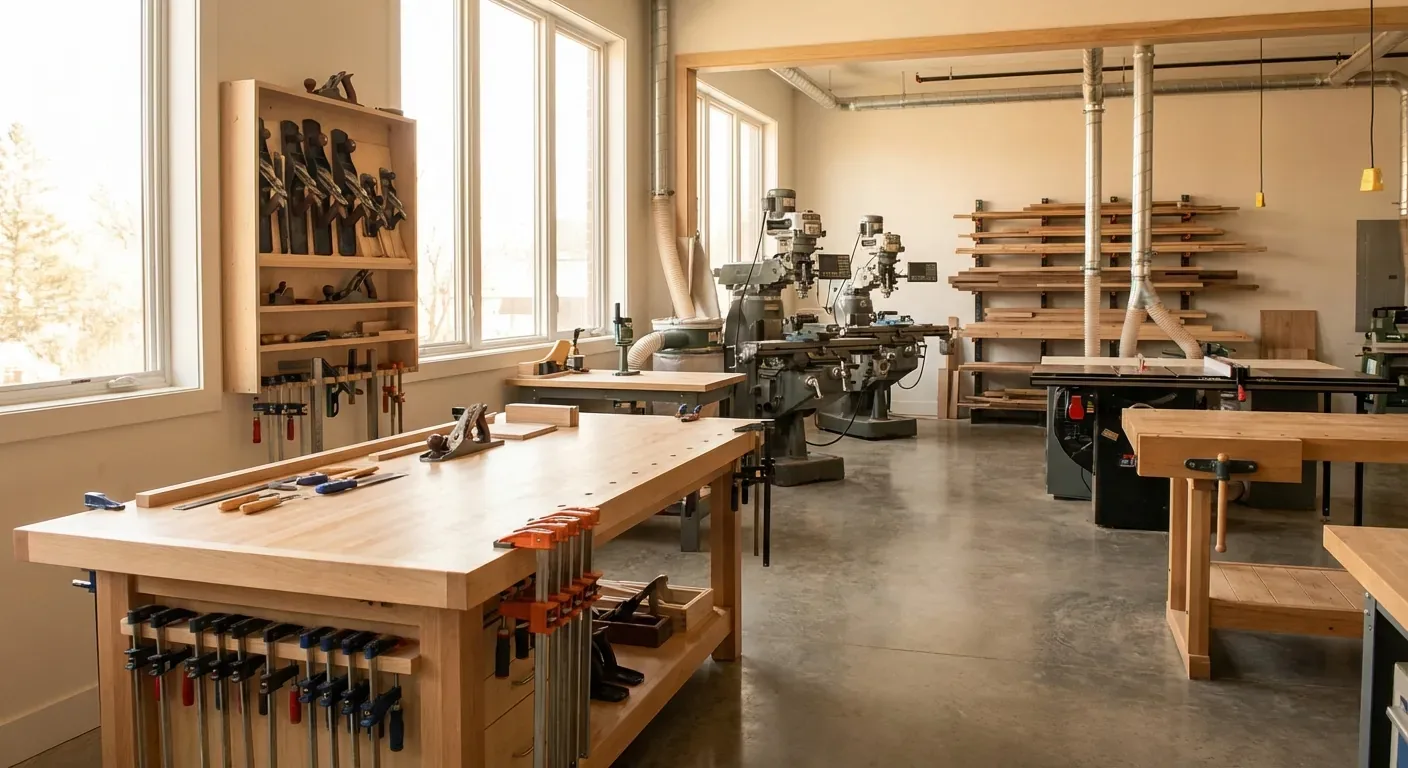
In most home workshops, floor space is the most valuable real estate you have. Every square foot occupied by a stationary cabinet is a square foot you can't use for maneuvering large sheets of plywood or assembling a dining table. Vertical storage is the ultimate solution to this constraint. By moving your tool storage to the walls, you clear the floor for movement and machinery. The two most popular systems for this are metal pegboards and French cleat walls. While traditional hardboard pegboard is common, it often fails under the weight of heavy woodworking tools like hand planes or large clamps, leading many pros to upgrade to more robust systems.
Metal pegboard systems offer a significant advantage in terms of durability and versatility. Unlike wood-based boards, metal panels won't warp or have their holes "blow out" over time. They also allow for the use of magnetic accessories, which are perfect for small items like drill bits, hex keys, or metal rulers. When setting up a wall system, it is vital to group tools by frequency of use. Tools used in every project—like your primary hammer, tape measure, and combination square—should be at eye level and centered over your main workspace. Less frequently used items, such as specialty pull saws or heavy-duty Forstner bits, can be placed higher up or toward the periphery of the wall.
The Versatility of French Cleats
French cleats are a favorite among woodworkers because they are "infinitely adjustable." A French cleat system consists of a series of horizontal strips with a 45-degree bevel attached to the wall, and matching beveled clips on the back of tool holders. This allows you to move, swap, and redesign your tool storage as your collection grows. If you buy a new set of chisels, you simply build a new chisel rack and hang it on the existing cleat. This modularity is essential for a growing shop where the layout today might not suit the projects of next year.
The beauty of the French cleat is that it encourages custom tool-holding solutions. You can build specific "holsters" for your drills, custom "tills" for your hand planes, and specialized racks for your squares. Because these holders are not permanently fixed to the wall, you can even take the entire rack off the wall and bring it to your workbench while you work, then return it when finished. This hybrid between "storage" and "work aid" is what makes French cleats the gold standard for many high-end furniture makers.
I highly recommend the Wall Control Metal Pegboard Organizer for any woodworker looking to move away from flimsy, sagging hardboard. This system is a "buy it once" solution that provides incredible strength—up to 10 times stronger than conventional pegboard. It’s best for the woodworker who wants a clean, industrial look and the peace of mind that their heavy iron hand planes or power tools won't pull the hooks out of the wall.
The standout feature is the dual-action engagement; it accepts both standard 1/4-inch pegboard hooks and Wall Control’s own patented slotted hooks, which lock into place and don't fall out when you grab a tool. The powder-coated finish is also a major plus, as it resists rust in non-climate-controlled garages. One drawback is the initial cost compared to DIY wood solutions, and you are somewhat locked into their ecosystem if you want the most secure fit. However, compared to building a French cleat system from scratch, this saves dozens of hours of shop time while providing a much more professional finish.
Small Parts, Big Headaches: Managing Hardware and Fasteners
Nothing kills the momentum of a project faster than being unable to find the specific 1-1/4 inch pocket hole screws you know you bought last week. Small parts management is often the most overlooked aspect of workshop organization, yet it is where the most time is lost. The key to managing hardware—screws, nails, dowels, biscuits, and hinges—is a combination of visibility and categorization. Storing hardware in their original cardboard boxes is a recipe for disaster, as the boxes fall apart, labels become obscured by sawdust, and you can't easily see your inventory levels.
A dedicated small-parts cabinet with clear drawers is the industry standard for a reason. It allows you to see exactly what you have at a glance. When organizing these bins, it is helpful to categorize them by fastener type (e.g., wood screws, machine screws, specialty fasteners) and then sub-categorize by length or gauge. For woodworkers, keeping a "primary fastener station" near the assembly area is a game-changer. This station should house your most-used items: 1-1/4", 1-1/2", and 2" wood screws, along with common sizes of brad nails and staples.
Labeling and Inventory Control
Even with clear bins, labeling is crucial. A simple label indicating the size, thread pitch, and head type (e.g., "1-1/4" #8 Torx Drive") prevents you from grabbing a Phillips head screw by mistake. Advanced organizers even include a "reorder" line on the label; when the stock falls below that line, it’s time to add it to the shopping list. This prevents the "mid-project hardware store run," which is the ultimate productivity killer.
For hardware that you use in large quantities, such as glue or common assembly screws, consider "bulk bins" that are larger and easier to reach into. For specialty hardware like brass hinges or drawer slides, which are often project-specific, using portable "organizer cases" with removable bins is a better strategy. You can take the entire case to your project, use what you need, and then store it on a shelf out of the way when the project is complete. This prevents your main hardware station from becoming cluttered with one-off items.
The Akro-Mils 64-Drawer Plastic Parts Storage Cabinet is the backbone of hardware organization for thousands of workshops. I recommend this specifically for woodworkers who deal with a high volume of small fasteners, from tiny brass screws for jewelry boxes to shelf pins and dowels. It’s best for those who have a dedicated wall space or benchtop area for a permanent hardware station.
The standout feature is the variety of drawer sizes available in different models, though the 64-drawer version offers the best granularity for a large screw collection. The drawers are clear, allowing for instant identification, and they feature "finger grips" that make them easy to open even with gloved hands. A minor drawback is that the plastic can be somewhat brittle if dropped when fully loaded with heavy steel bolts, and the unit itself should be wall-mounted to prevent tipping. Compared to cheaper "no-name" brands, the Akro-Mils drawers slide much more smoothly and the frame is more rigid, making it a worthwhile investment for a professional-feeling shop.
Mobility: Creating a Flexible Workshop Layout
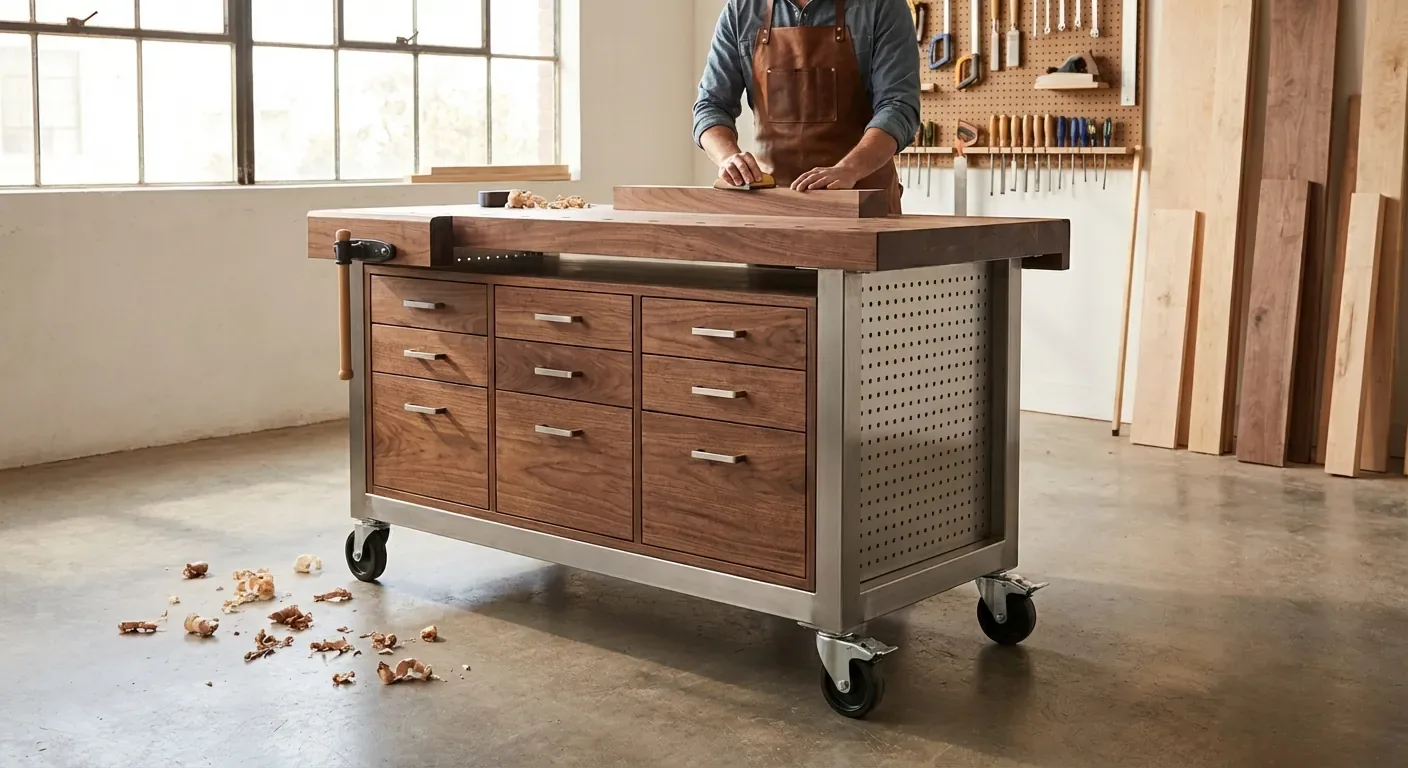
Unless you are blessed with a 2,000-square-foot dedicated shop, flexibility is your greatest asset. The ability to reconfigure your space based on the current project phase is what separates a cramped shop from a functional one. Mobility is achieved primarily through the use of high-quality locking casters on every major tool and workbench. If your table saw, jointer, and assembly table are all on wheels, you can move the "milling station" to the center of the room when processing long boards, then tuck everything against the walls when it’s time for assembly or finishing.
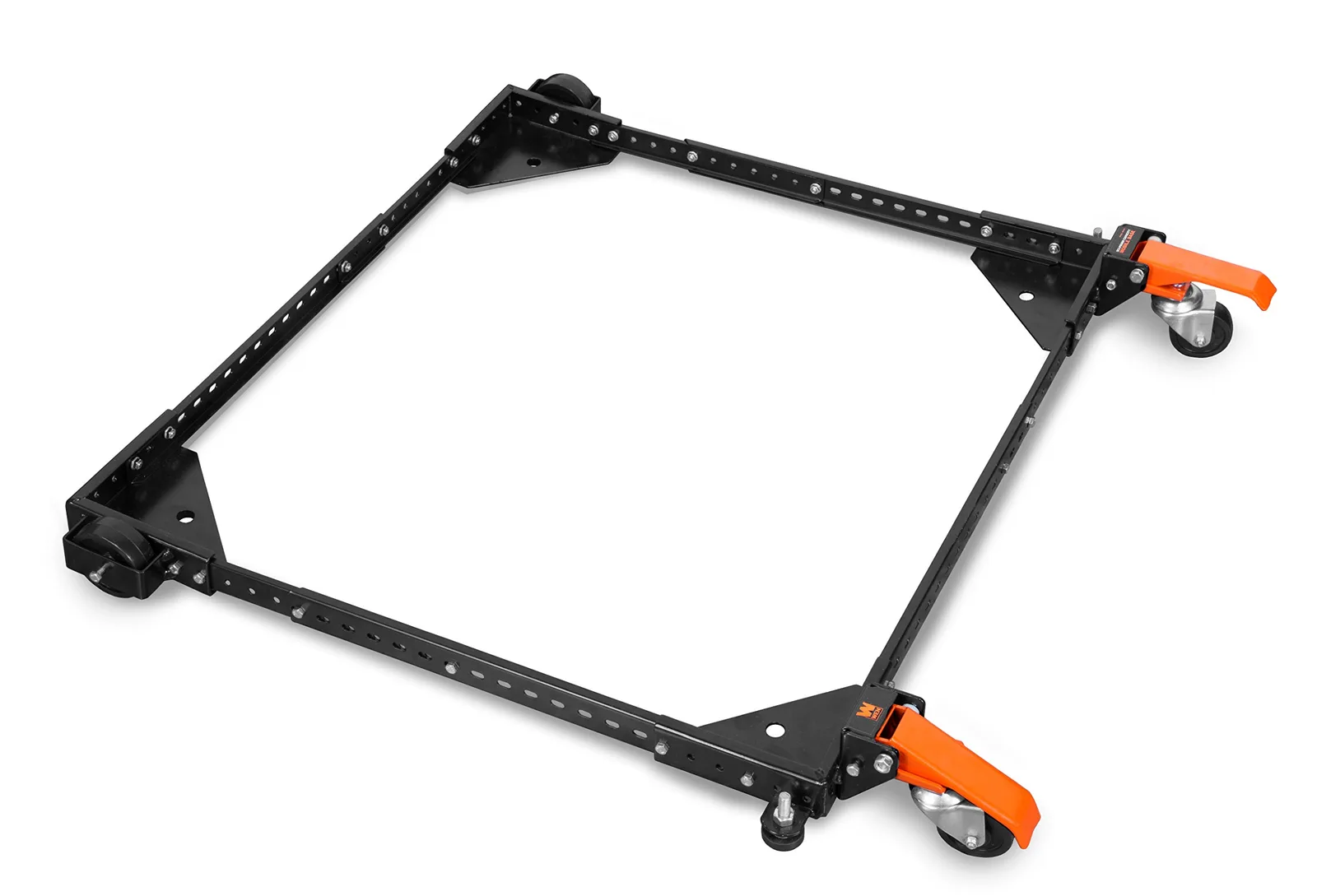
The "Mobile Base" is a specialized piece of equipment designed to turn heavy, stationary machinery into portable units. When choosing a mobile base, look for those with "all-swivel" casters, which allow for 360-degree movement in tight spaces. "Step-down" casters are also preferred because they allow the machine to sit firmly on its own feet when in use, ensuring stability and accuracy during heavy cuts. If a tool is on wheels that don't lock properly, the vibration of the motor can cause the machine to "walk" across the floor, which is both frustrating and dangerous.
The Utility of the Rolling Project Cart
Beyond just putting machines on wheels, every organized shop needs at least one rolling project cart. This cart serves as a "staging area" for the specific project you are currently working on. It should hold the project's cut list, the specific hardware needed, the finish, and the tools required for that phase. As you move from the table saw to the assembly table, the cart moves with you. This keeps your main workbench clear of "clutter" and ensures that you aren't constantly walking back and forth to your wall storage for the same three tools.
A project cart can also double as an outfeed table for your table saw or a mounting point for a benchtop tool like a spindle sander or a miter saw. By standardizing the height of your mobile carts to match your table saw's height, you create a modular system where every surface can support every other surface. This "work-surface harmony" is a hallmark of a masterfully organized small shop.
Lumber Management: From Slabs to Scrap Offcuts
Lumber storage is often the most difficult organizational challenge because wood is heavy, bulky, and sensitive to environmental changes. Stacking lumber against a wall is a recipe for warped boards and a massive trip hazard. A proper lumber rack—whether wall-mounted or a free-standing "A-frame"—is essential for keeping your stock flat, dry, and accessible. Horizontal storage is generally preferred for long-term seasoning, as it allows the wood to be supported along its entire length, preventing "bowing" or "crowning."
When organizing your lumber, categorize it by species and thickness. Keeping your "primary" stock (like 4/4 walnut or cherry) separate from your "secondary" stock (like pine or plywood) makes it much easier to assess your inventory before starting a project. It’s also wise to store sheet goods vertically in a dedicated "sheet goods rack" to prevent them from taking up too much floor space. A well-designed sheet goods rack will have a "lip" that makes it easy to slide sheets in and out without straining your back.
Managing the "Scrap" Problem
Every woodworker struggles with scrap management. The "I might use this someday" mentality leads to overflowing bins of useless offcuts. To organize scraps effectively, implement a "Size-Based Sorting System." Create three bins: one for long, thin "stick" scraps (useful for cauls or spacers), one for medium-sized "block" scraps (useful for jigs or small boxes), and a "burn/toss" bin for anything smaller than 6 inches.
Periodically—perhaps every three months—perform a "Scrap Audit." If the bins are overflowing, it’s time to either make a small project or clear them out. A great tip for scrap organization is to store offcuts from a specific project together in a labeled bin until that project is 100% complete. There is nothing worse than throwing away a "scrap" only to realize the next day that you need it to replace a piece you mis-cut.
The Bora Portamate Wood Organizer (PBR-001) is the definitive solution for horizontal lumber storage. I recommend this for any woodworker who buys lumber in bulk or likes to keep a variety of species on hand. It’s best for mounting on garage or shop walls where you have at least 6-8 feet of horizontal clearance.
The standout feature is the 6-level storage capacity, with each level capable of holding up to 100 lbs (600 lbs total). The powder-coated steel construction is incredibly rigid, ensuring that even your heaviest oak slabs won't cause the arms to sag. It effectively moves hundreds of pounds of wood off the floor and into the "dead space" near the ceiling. A potential drawback is that installation requires finding and drilling into multiple studs, which can be tricky in some finished garages. Compared to DIY wooden racks, the Bora system is much thinner, allowing you to store more wood in the same vertical footprint without the bulk of 2x4 supports.
The Workbench Hub: Maximizing Your Primary Workspace
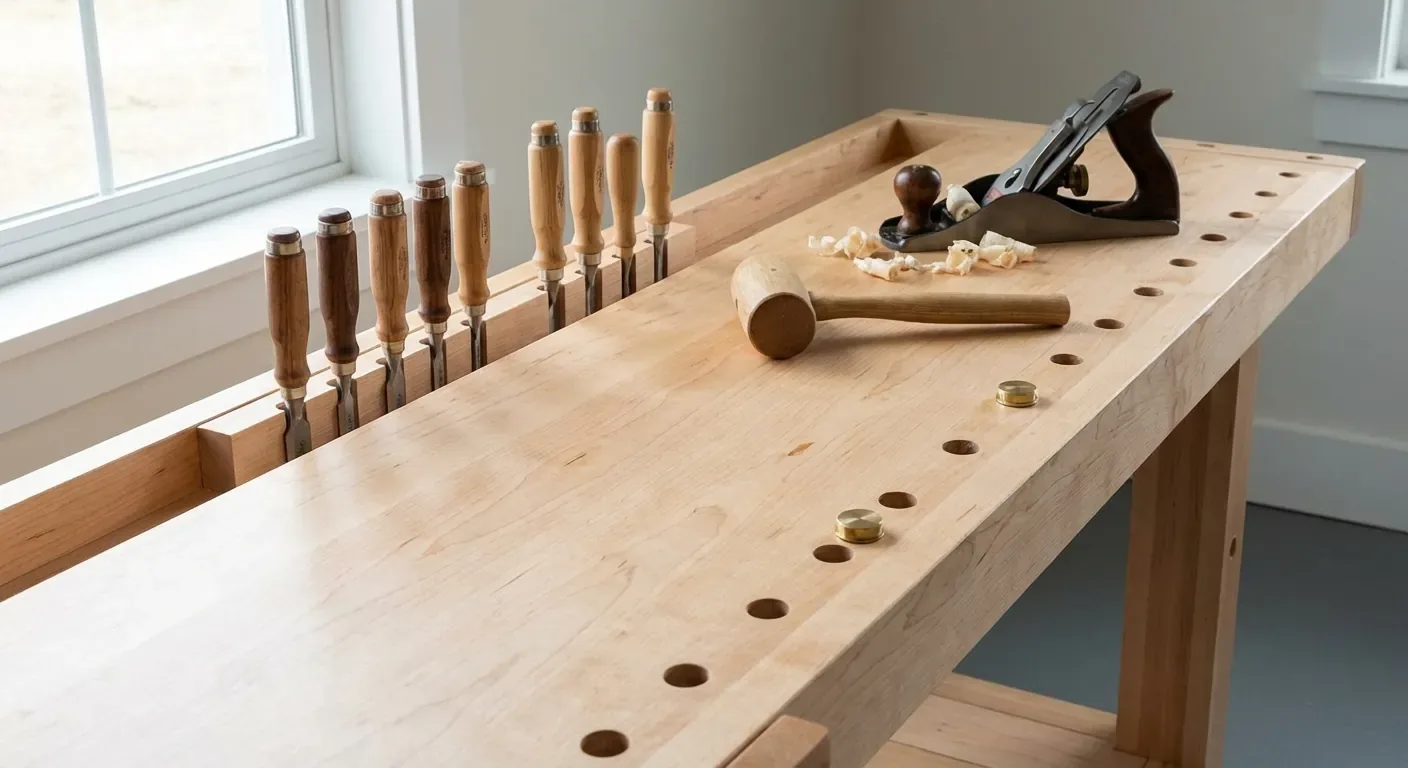
The workbench is the heart of the workshop, and its organization determines the pace of your hand-tool work and assembly. A common mistake is to treat the area under the workbench as a "catch-all" for miscellaneous junk. Instead, this space should be utilized for "high-frequency" items. Many woodworkers build custom "cabinetry-under-bench" units that house their most-used hand tools, such as planes, chisels, and saws. This keeps the tools protected from dust but immediately available.
The top of the workbench should be kept as clear as possible. To facilitate this, implement a "Tool Well" or a "side-hanging" system for tools currently in use. When you’re working on a joinery task, you might have four different chisels, a mallet, and a marking gauge out. If they stay on the benchtop, they get in the way of the workpiece. If they have a temporary "parking spot" on the side of the bench, your workspace stays clean and your tools stay safe from being knocked onto the floor.
Workholding Organization
Organizing your workholding—clamps, bench dogs, holdfasts, and vises—is just as important as organizing your tools. Clamps are notorious for taking up space. A wall-mounted "clamp rack" categorized by type (parallel jaw, F-style, pipe clamps) is the most efficient way to store them. For bench dogs and small holdfasts, a dedicated drawer or a "swing-out" tray attached to the workbench leg ensures they are always where you need them when you're ready to secure a workpiece.
Power and Air: Managing the Invisible Clutter
Cables and hoses are the "hidden" clutter of a workshop. They are trip hazards, they get tangled in saw blades, and they make cleaning the floor nearly impossible. Effective power management involves two strategies: "Fixed Power" for stationary machines and "Retractable Power" for handheld tools and the assembly area. For stationary tools, try to run power lines along the ceiling or through the floor (if possible) to avoid "snakes" across the walking paths.
Retractable cord reels are a game-changer for the center of the shop. By mounting a reel to the ceiling above your assembly table, you can pull power down when you need to use a sander or a router, and then have it zip out of the way when you're done. This keeps the floor 100% clear. The same logic applies to compressed air. If you use pneumatic nailers or blow-off guns, a retractable air hose reel prevents the "spaghetti" of orange hoses that usually litters shop floors.
Charging Stations
In the modern shop, cordless tools are king. However, a mess of different chargers and batteries can quickly take over a benchtop. Building a "Battery Charging Station" is a high-priority organization project. This station should have a dedicated power strip, mounts for all your chargers, and "slots" for the batteries themselves. Many woodworkers organize their batteries by "Charged" and "Dead" sections, so they never grab a half-empty battery in the middle of a critical task.
The Diamondback Retractable Power Cord Reel is an essential upgrade for any shop layout. I recommend this for woodworkers who find themselves constantly tripping over extension cords or searching for an outlet near their assembly table. It’s best for ceiling mounting in the center of the shop.
The standout feature is the 50-foot, 12-gauge cord, which is heavy-duty enough to run high-amperage tools like routers or circular saws without significant voltage drop. The "adjustable cord stopper" allows you to set exactly how much lead hangs down, keeping it within reach but out of the way. One drawback is that the internal spring is quite powerful, so you have to guide the cord back in to prevent it from "whipping." Compared to cheaper 14-gauge or 16-gauge reels, this unit handles the heat of continuous tool use much better and won't trip your breakers under load.
Dust Collection Infrastructure and Workflow
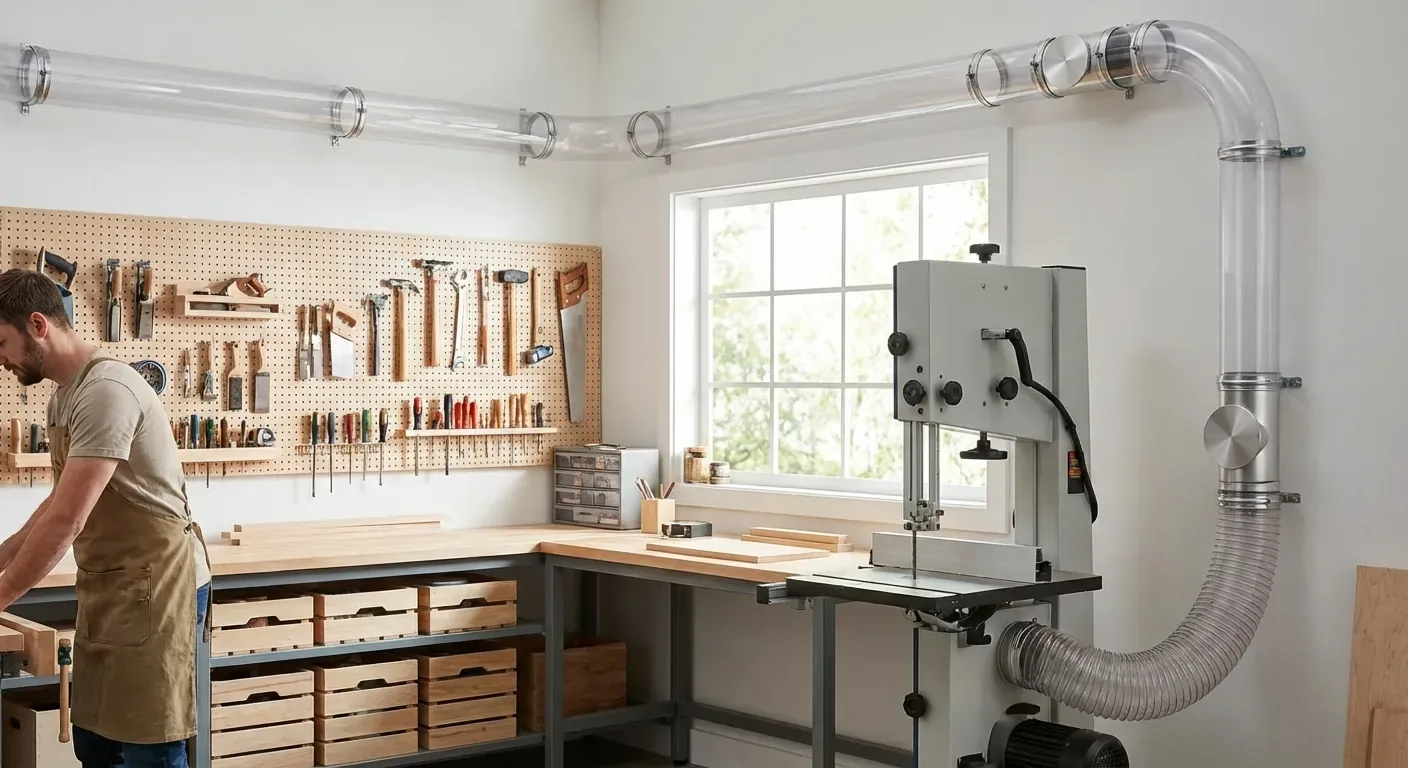
Dust collection is often viewed as a luxury, but in terms of organization, it is a necessity. A shop covered in a layer of fine dust is harder to organize because labels become unreadable, drawers stick, and surfaces become slippery. A "centralized" dust collection system with permanent ductwork is the gold standard, but even a small shop with a "shop vac and cyclone" setup can be highly organized. The key is to minimize the "friction" of using the dust collector. If you have to move the hose and plug it in every time you change tools, you eventually stop doing it.
Implementing "Blast Gates" and "Quick-Connect" fittings allows you to keep the vacuum source connected to multiple machines simultaneously. Organizing your hoses so they run overhead or along the walls—rather than across the floor—is vital for safety. For handheld power tools, using a "tool-triggered" switch (which turns the vacuum on automatically when the tool starts) ensures that dust collection is an integrated part of your workflow rather than an extra step.
PPE Organization
Safety equipment—safety glasses, hearing protection, and respirators—should be stored at the "Point of Entry" to the shop or at the "Point of Use" for specific machines. If you have to go looking for your safety glasses, you're more likely to "just make this one quick cut" without them. A simple "Safety Station" with a mirror (to check for grit in your eyes) and a dedicated rack for your "daily driver" PPE ensures that staying safe is the easiest path to take.
The 5S System: Maintaining Your Organized Shop
The greatest challenge of workshop organization isn't the initial setup; it’s the maintenance. Woodworking is a messy process that creates waste at every step. Without a system for maintenance, even the best-organized shop will return to chaos within a few projects. Many professional shops adopt the "5S" methodology from Japanese manufacturing: Sort, Set in order, Shine, Standardize, and Sustain.
- Sort: Periodically go through your tools and materials. If you haven't used a jig in two years, get rid of it.
- Set in Order: Every tool has a home. Use "shadow boarding" (drawing the outline of the tool on the wall) to make it obvious where things go.
- Shine: Clean the shop at the end of every day. A 10-minute "sweep-down" prevents dust buildup and allows you to start the next morning with a "fresh" mind.
- Standardize: Use the same types of bins, labels, and storage methods throughout the shop to reduce visual complexity.
- Sustain: Make organization a habit. The most important rule is: "Don't put it down, put it away."
By treating organization as a "skill" to be practiced—just like cutting dovetails or applying a finish—you will find that your time in the shop becomes more productive, more creative, and ultimately, more enjoyable. An organized shop is a reflection of an organized mind, and it is the foundation upon which great craftsmanship is built.
Frequently Asked Questions
What is the best way to start organizing a completely messy workshop?
The best way to start is by "emptying the container." If possible, move everything out of the shop or into one half of the room. This allows you to see the space clearly and clean the floors and walls. Start by "Sorting"—discarding broken tools, dried-up glue, and useless scraps. Once you have only what you need, group items by "Zone" (e.g., all sharpening tools together, all drilling tools together). Don't buy any storage bins until you know exactly what you need to store. Start with the most frequently used tools and give them the "prime real estate" at eye level near your workbench.
Starting small is key. Don't try to build a full French cleat wall in one weekend. Instead, focus on one "Pain Point." If you spend 10 minutes a day looking for drill bits, spend your first Saturday building or buying a dedicated drill bit organizer. Solving these small frustrations provides the "dopamine hit" needed to keep going with larger organizational projects.
How do I organize a workshop in a very small space, like a one-car garage?
In a small space, "Verticality" and "Mobility" are your two best friends. You must use every inch of wall space, often going all the way to the ceiling for long-term storage of items like holiday decorations or rarely used power tools. Use "Flip-Top" tool stands to house two machines (like a planer and a sander) in the footprint of one. These stands allow you to use one tool, then flip the top over to access the other.
Additionally, standardizing the height of all your work surfaces (workbench, table saw, and tool stands) allows them to act as outfeed support for each other. This "modular" approach means you don't need a dedicated 8-foot outfeed table; your assembly cart can simply be rolled into position when you're ripping long boards. Finally, be ruthless with your scrap pile. In a one-car garage, you simply don't have the room to keep every 4-inch offcut of plywood.
Is a French cleat system better than a traditional pegboard?
There is no "better," only "better for your needs." A French cleat system is superior for woodworkers who enjoy building their own custom tool holders and who want the maximum amount of flexibility. It is incredibly strong and can hold heavy items like air compressors or large cabinets. However, it takes a significant amount of time to build the cleats and the individual tool holders.
A metal pegboard system (like Wall Control) is better for someone who wants to get organized now and prefers a clean, industrial look. It is much faster to install and offers a wide variety of "off-the-shelf" hooks and bins. If you find yourself constantly changing your mind about where tools should go, or if you have a lot of heavy, oddly shaped tools, the French cleat is likely the better long-term investment for your shop.
How can I keep my workshop organized when I'm in the middle of a big project?
The key is the "10-Minute Reset." At the end of every shop session, regardless of how tired you are, spend 10 minutes putting tools back in their homes and sweeping the major sawdust piles. You don't have to make the shop "perfect," but you should clear the main work surfaces. This prevents the "compounding clutter" effect where one misplaced tool leads to five more, eventually making the shop unusable.
Another strategy is the "Project Tray." Use a small tray or bin to hold all the tools and hardware specifically for the task you are doing (e.g., all the tools for cutting tenons). When you move to the next task, all those tools go back to the wall, and the tray is refilled with the next set of tools. This keeps the "in-use" tools from migrating across the entire shop.
What are the most common workshop organization mistakes?
The most common mistake is "Over-Building." Woodworkers often spend months building elaborate, beautiful tool cabinets and drawers, only to find that their workflow has changed or they’ve bought new tools that don't fit the custom slots. Start with "flexible" storage like open shelves or basic pegboards. Only when you are 100% sure of where a tool "wants" to live should you build a permanent, custom home for it.
Another mistake is "Deep Storage." Any drawer or cabinet deeper than 12-18 inches becomes a "black hole" where tools go to be forgotten. Always favor shallow storage where everything is visible. Finally, many woodworkers forget to organize for "Cleanability." If you have hundreds of small items sitting on open shelves, they will all get covered in fine sawdust. Use closed drawers or clear plastic bins for small items to keep them clean and ready to use.
How much should I spend on workshop organization?
You can organize a shop for almost $0 using scrap plywood and DIY solutions, or you can spend thousands on high-end metal cabinetry and modular systems. A good rule of thumb is to spend about 10-15% of your total "tool budget" on organization and storage. If you have $5,000 worth of tools, spending $500-$750 on high-quality racks, bins, and mobile bases is a wise investment that protects your tools and increases your productivity.
However, don't feel the need to buy everything at once. Start with the "Foundations": a good lumber rack, a solid hardware organizer, and a way to get your primary tools on the wall. As you spend more time in the shop, you will naturally identify which areas need more investment. Often, the most effective organizational "hacks" are the ones you build yourself for the cost of a single sheet of plywood.
How do I manage dust in an organized way?
Dust management should be "Built-In," not "Added-On." This means integrating dust ports into your workbenches and tool stands. Use "Hose Management" clips or "Boom Arms" to keep vacuum hoses from dragging across your workpieces. An organized shop uses a "Two-Tier" dust system: a large dust collector for "heavy" waste (chips from planers and jointers) and a high-efficiency shop vac with a HEPA filter for "fine" dust (from sanders and saws).
Labeling your blast gates also helps. If you have a complex system of pipes, it’s easy to forget which gate goes to which machine. A simple label like "Table Saw" or "Band Saw" on the gate handle ensures you always have maximum suction where you need it. Lastly, keep a "Clean-Up Kit"—a high-quality shop brush, a dustpan, and a microfiber cloth—in a dedicated, easy-to-reach spot so that cleaning becomes an effortless part of your routine.
Explore the recommendations.
Check Amazon for current product details, available options, and pricing.
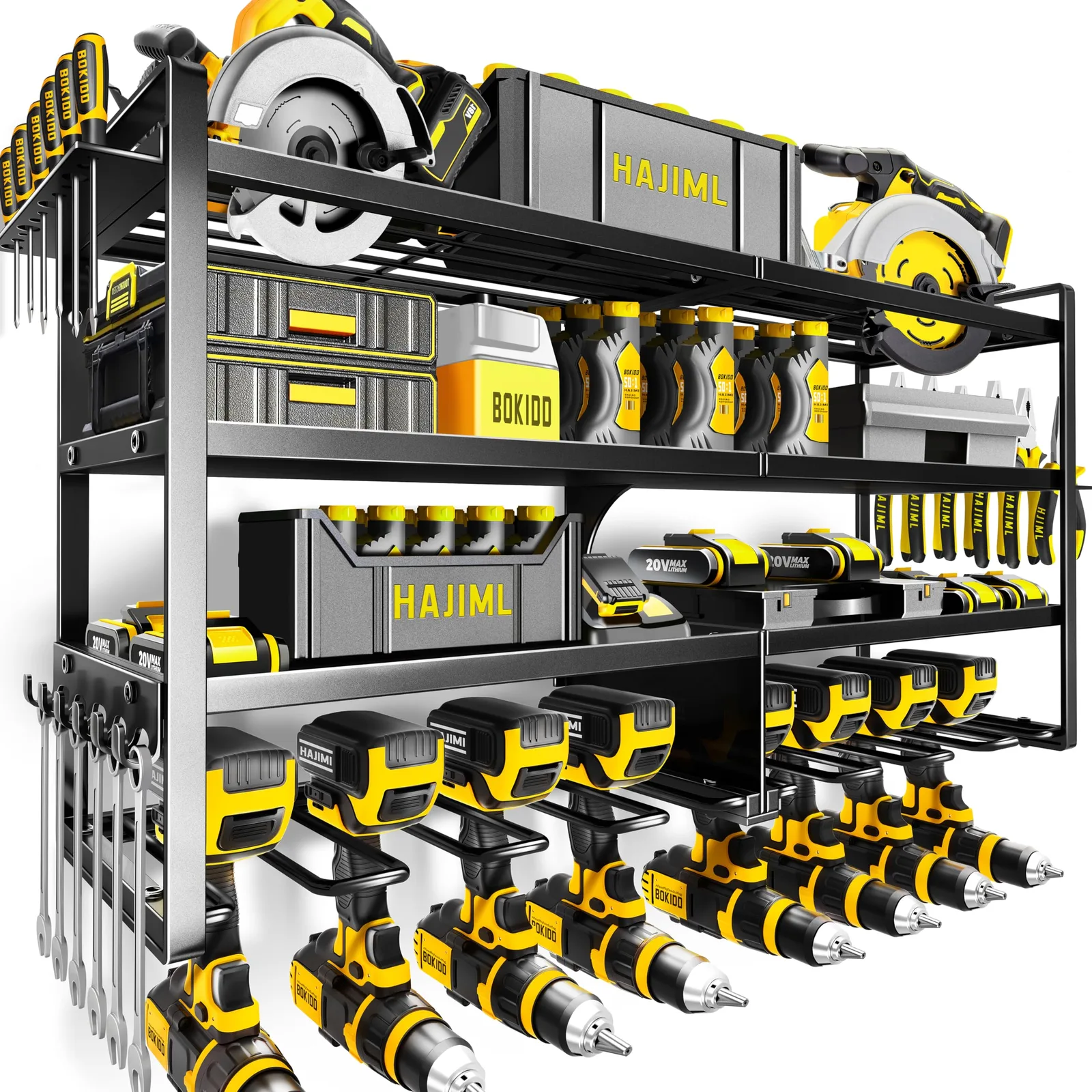
Kodreat Power Tool Organizer Wall Mount,4 Layers Heavy Duty Storage Rack with 8 Drill Holder, Easy Installation, Tool Organizer Wall Mount for Garage Workshop and Home Organization. black 4shelves 8slots
Product details
Durable Metal Construction: Our power tool organizer wall mount is crafted from high-quality metal, ensuring it is rust-resistant, corrosion-proof,and scratch-resistant, providing long-lasting durability while maintaining a smooth surface that keeps your tools safe. Spacious Four-Tier Design: This cordless tool organizer features a generous four-layer storage capacity, designed to hold up to 400 lbs.Perfect for organizing and maximizing space in garages, workshops, and tool sheds, it transforms cluttered areas into efficient workspaces. Easy Installation for Space-Saving: Our tool organizers and storage solution is designed for hassle-free setup. With a user-friendly manual and high-quality installation accessories included, you can assemble it in just minutes, reclaiming valuable space quickly and effectively. Safe and Secure Design: Featuring discreet weld points and a polished finish, this power tool organizer minimizes the risk of injury, ensuring you and your family can handle tools safely. Enjoy a tidy workspace without the fear of sharp edges! Perfect Gift for Any Occasion: Whether for Father's Day, Christmas,or Thanksgiving, this versatile tool storage organizer makes an ideal gift for fathers, husbands, and brothers. Help your loved ones stay organized with a thoughtful present they will appreciate!
- Durable Metal Construction: Our power tool organizer wall mount is crafted from high-quality metal, ensuring it is rust-resistant, corrosion-proof,and scratch-resistant, providing long-lasting durability while maintaining a smooth surface that keeps your tools safe.
- Spacious Four-Tier Design: This cordless tool organizer features a generous four-layer storage capacity, designed to hold up to 400 lbs.Perfect for organizing and maximizing space in garages, workshops, and tool sheds, it transforms cluttered areas into efficient workspaces.
- Easy Installation for Space-Saving: Our tool organizers and storage solution is designed for hassle-free setup. With a user-friendly manual and high-quality installation accessories included, you can assemble it in just minutes, reclaiming valuable space quickly and effectively.
- Safe and Secure Design: Featuring discreet weld points and a polished finish, this power tool organizer minimizes the risk of injury, ensuring you and your family can handle tools safely. Enjoy a tidy workspace without the fear of sharp edges!
- Perfect Gift for Any Occasion: Whether for Father's Day, Christmas,or Thanksgiving, this versatile tool storage organizer makes an ideal gift for fathers, husbands, and brothers. Help your loved ones stay organized with a thoughtful present they will appreciate!
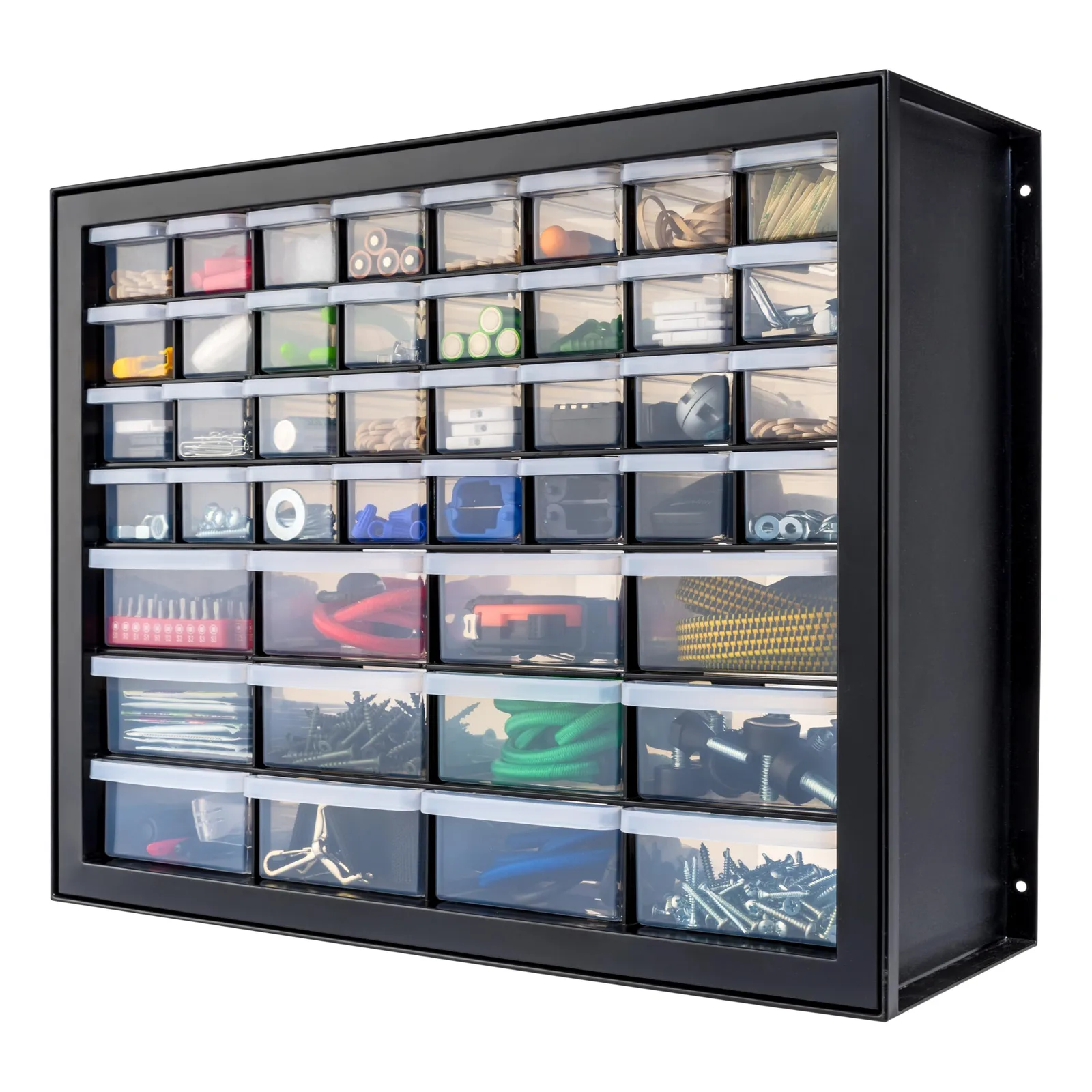
IRIS USA Screw Tool Organizer Small Parts Cabinet, 44-Drawer, Electronics Hardware Nuts and Bolts Plastic Storage Drawers Garage Storage, Stackable Bead Craft Organizer Building Bricks Sorter, Black Black 44 Drawer
Product details
MULTI-PURPOSE ORGANIZER: Perfect storage solution tool to organize screws, hardware, small parts, nuts and bolts, stationery, office and classroom supplies, crafts, beads or sewing supplies, and fishing gear. STACK OR WALL MOUNT: The cabinet’s grooves on the lid securely lock in one on top of another when stacked. It can be wall-mounted and used to organize screws, hardware, tools, and small parts. MULTI-DRAWERS: Sort, store and organize screws, hardware, small parts, nails, and tools with these multi-drawers to identify and grab things easily and quickly. MADE IN USA: High-quality, recyclable materials are used for our domestically-manufactured products. The sturdy plastic makes these durable, and the smooth glide drawers give you easy access to contents. DIMENSION: 19.5”L X 7”W 15.5”H (Large drawer dimensions: 6”L x 4”W x 2”H; small drawer dimensions: 6”L x 1. 75”W x 1. 5”H).
- MULTI-PURPOSE ORGANIZER: Perfect storage solution tool to organize screws, hardware, small parts, nuts and bolts, stationery, office and classroom supplies, crafts, beads or sewing supplies, and fishing gear.
- STACK OR WALL MOUNT: The cabinet’s grooves on the lid securely lock in one on top of another when stacked. It can be wall-mounted and used to organize screws, hardware, tools, and small parts.
- MULTI-DRAWERS: Sort, store and organize screws, hardware, small parts, nails, and tools with these multi-drawers to identify and grab things easily and quickly.
- MADE IN USA: High-quality, recyclable materials are used for our domestically-manufactured products. The sturdy plastic makes these durable, and the smooth glide drawers give you easy access to contents.
- DIMENSION: 19.5”L X 7”W 15.5”H (Large drawer dimensions: 6”L x 4”W x 2”H; small drawer dimensions: 6”L x 1. 75”W x 1. 5”H).
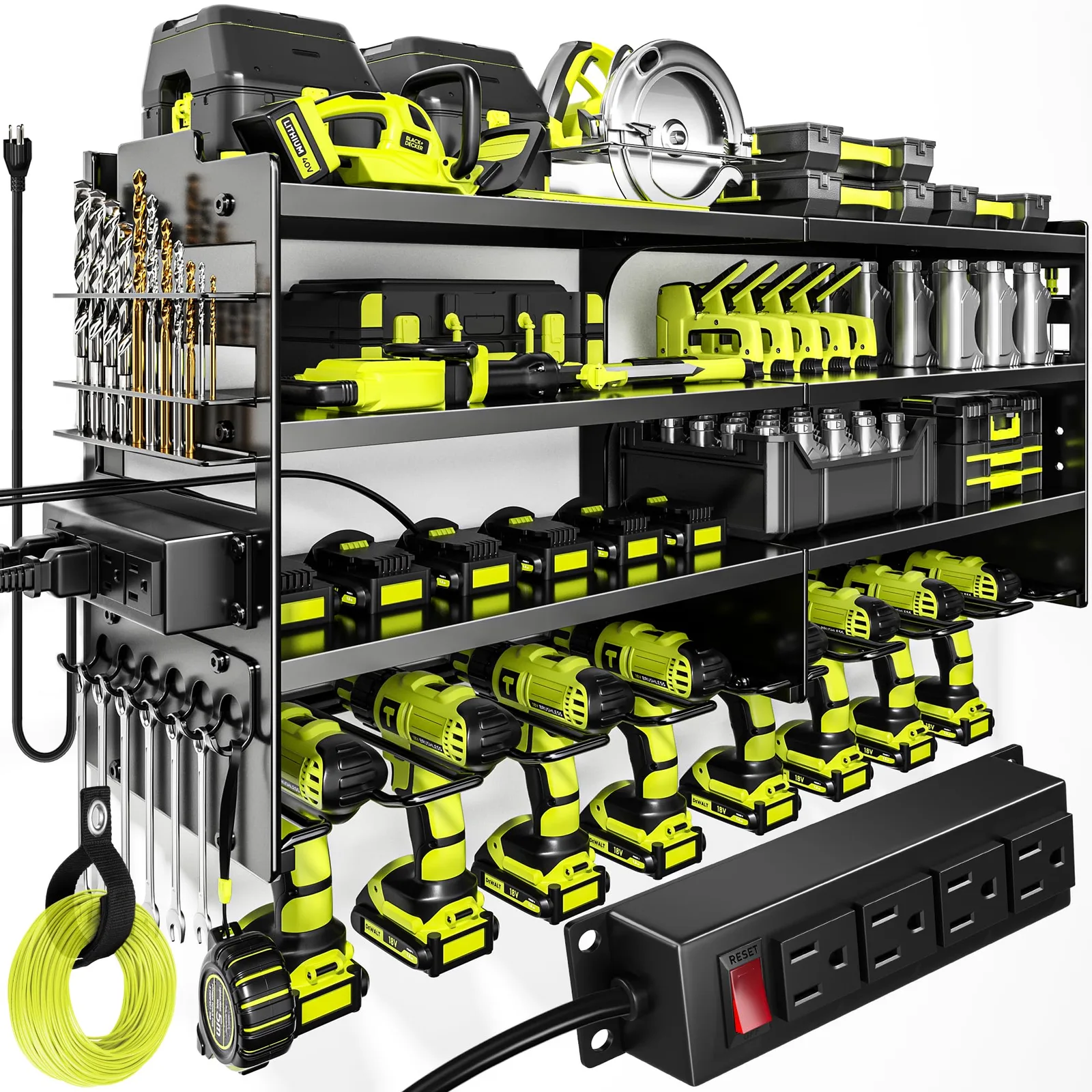
POKIPO Large Power Tool Organizer Wall Mount with Charging Station,4 Layer Heavy Duty Metal Tool Storage Rack Loads 600lbs with 8 Cordless Drill Holder,Battery Utility Rack Loads with 4 Power Strip Black Large with Power Station
Product details
4-Outlet Power Strip:This garage shelf wall mount features an integrated 4-outlet power strip with a 6.5-foot cord for easy charging. Charge your tools directly on the shelf without the hassle of searching for outlets. By combining storage and functionality, this tool rack saves space while ensuring your power tools are always ready for use. Heavy-Duty 600lbs Load Capacity: Constructed from high-quality, industrial-grade metal,our power tool organizer wall mount with charging station supports up to 600lbs, ensuring exceptional durability. Extensive load-bearing tests confirm its strength, allowing you to store heavy tools with confidence, free from concerns about breakage or instability. It is ideal for securely holding power tools of any size or weight. 4-Tier Tool Rack: This tool storage rack with power strip features two side drill bit racks, a hook rack, six shelves, eight drill slots, and an four-outlet power strip, making it your all-in-one solution. Easily organize your toolbox, drills, chargers, batteries, hammers, and screwdrivers. With ample space for all your garage tools, this rack optimizes storage and effortlessly eliminates clutter. Space-Saving Tool Organization: this power tool battery shelf transforms cluttered tool areas into clean, Ideal for garages, workshops, and tool rooms, it accommodates a wide range of tools. Designed to keep workbenches clear and maximize storage, this organizer is essential for any professional or DIY enthusiast. Hassle-Free Quick Installation: Our cordless drill holder comes with a comprehensive manual and high-quality installation accessories for swift and straightforward assembly. It is compatible with wooden walls, concrete surfaces, and pegboards, allowing it to integrate seamlessly into your workspace. Assemble it in just minutes and enjoy a tidy, easily accessible storage solution for your tools.
- 4-Outlet Power Strip:This garage shelf wall mount features an integrated 4-outlet power strip with a 6.5-foot cord for easy charging. Charge your tools directly on the shelf without the hassle of searching for outlets. By combining storage and functionality, this tool rack saves space while ensuring your power tools are always ready for use.
- Heavy-Duty 600lbs Load Capacity: Constructed from high-quality, industrial-grade metal,our power tool organizer wall mount with charging station supports up to 600lbs, ensuring exceptional durability. Extensive load-bearing tests confirm its strength, allowing you to store heavy tools with confidence, free from concerns about breakage or instability. It is ideal for securely holding power tools of any size or weight.
- 4-Tier Tool Rack: This tool storage rack with power strip features two side drill bit racks, a hook rack, six shelves, eight drill slots, and an four-outlet power strip, making it your all-in-one solution. Easily organize your toolbox, drills, chargers, batteries, hammers, and screwdrivers. With ample space for all your garage tools, this rack optimizes storage and effortlessly eliminates clutter.
- Space-Saving Tool Organization: this power tool battery shelf transforms cluttered tool areas into clean, Ideal for garages, workshops, and tool rooms, it accommodates a wide range of tools. Designed to keep workbenches clear and maximize storage, this organizer is essential for any professional or DIY enthusiast.
- Hassle-Free Quick Installation: Our cordless drill holder comes with a comprehensive manual and high-quality installation accessories for swift and straightforward assembly. It is compatible with wooden walls, concrete surfaces, and pegboards, allowing it to integrate seamlessly into your workspace. Assemble it in just minutes and enjoy a tidy, easily accessible storage solution for your tools.
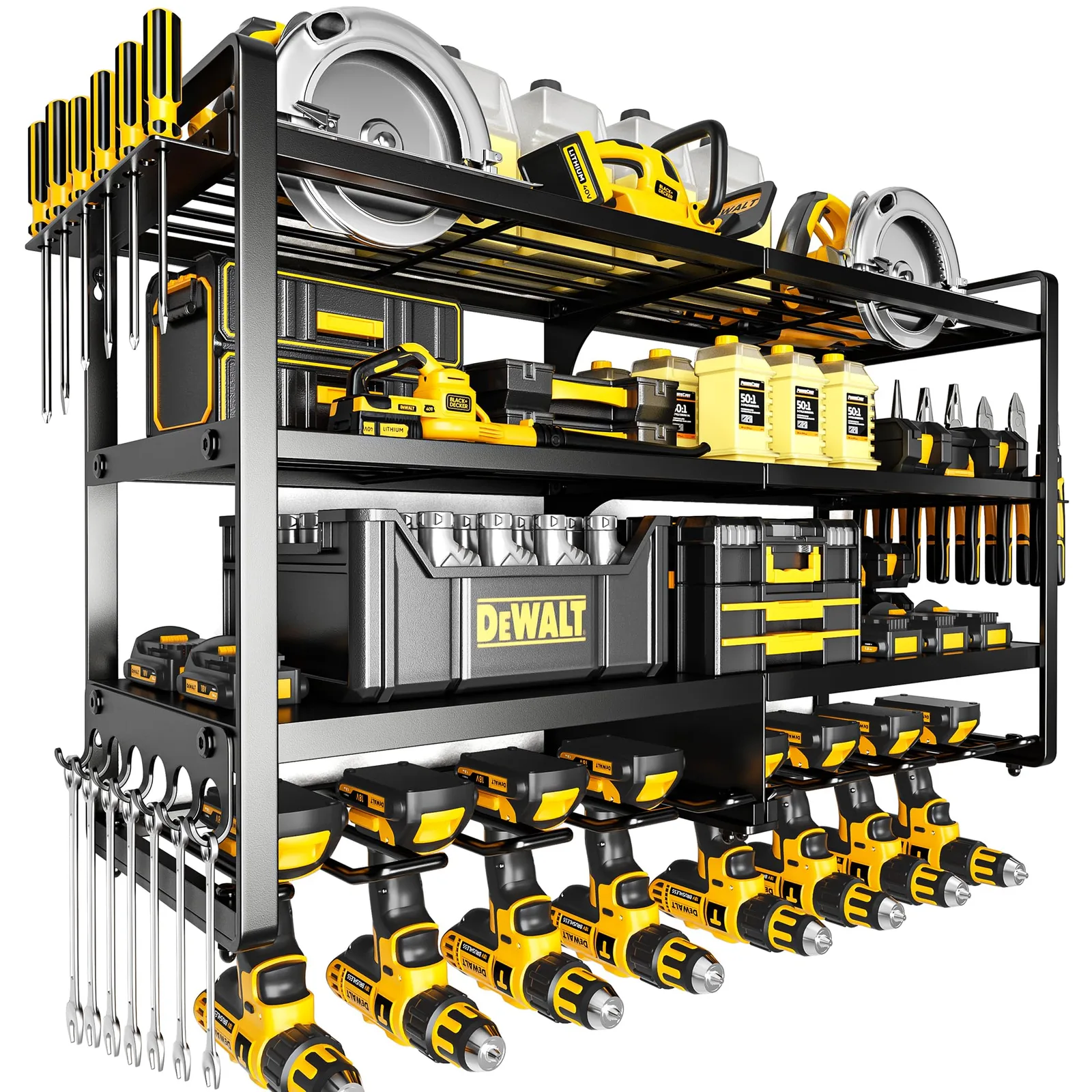
POKIPO Large Power Tool Organizer Wall Mount,4 Layers Heavy Duty Metal Loads 400lbs,Power Tool Shelf Battery Storage with 8 Cordless Drill Holder,Utility Racks for Garage Workshop Black
Product details
High-Quality Metal Materials: Our tool holder is constructed from heavy industrial-grade steel. It is resistant to rust and corrosion, scratch-resistant, durable, and smooth. Each edge of the metal plates is polished to ensure a smooth finish, preventing any scratches to your fingers. The upgraded welding points and coating help prevent deformation while enhancing strength and longevity. Four Layers of Large-Capacity Tool Racks: Our upgraded drill stand, measuring 36.4 x 11.7 x 8 inches, is both taller and wider than traditional tool racks. The top three layers are designed to accommodate heavy tools, such as toolboxes, charging stations, and large power tools. The bottom layer can hold up to eight cordless drills, while the side racks feature designated spaces for a hammer, pliers, and screwdrivers. Support up to 400 Pounds. Our tool holder is constructed from heavy-duty, industrial-grade steel, ensuring it will not break or bend. This design enhances both load-bearing capacity and durability. Our power tool holders can accommodate a wide range of power tool weights, supporting up to 400 pounds. Suitable for Various Occasions and the Perfect Gift: The tool rack can be mounted in a garage, tool room, workshop, or other spaces. It makes an excellent present for Father's Day, Christmas, Thanksgiving, or any special holiday, making it a thoughtful choice for fathers, husbands, brothers, and more. Easy to Install and Space-Saving: Our cordless tool holders are simple to install. We provide manuals and high-quality installation accessories, enabling you to assemble an ideal garage wall tool organization unit in just a few minutes. This tool rack can transform your cluttered tool bench or underutilized wall space into a clean and efficient workspace.
- High-Quality Metal Materials: Our tool holder is constructed from heavy industrial-grade steel. It is resistant to rust and corrosion, scratch-resistant, durable, and smooth. Each edge of the metal plates is polished to ensure a smooth finish, preventing any scratches to your fingers. The upgraded welding points and coating help prevent deformation while enhancing strength and longevity.
- Four Layers of Large-Capacity Tool Racks: Our upgraded drill stand, measuring 36.4 x 11.7 x 8 inches, is both taller and wider than traditional tool racks. The top three layers are designed to accommodate heavy tools, such as toolboxes, charging stations, and large power tools. The bottom layer can hold up to eight cordless drills, while the side racks feature designated spaces for a hammer, pliers, and screwdrivers.
- Support up to 400 Pounds. Our tool holder is constructed from heavy-duty, industrial-grade steel, ensuring it will not break or bend. This design enhances both load-bearing capacity and durability. Our power tool holders can accommodate a wide range of power tool weights, supporting up to 400 pounds.
- Suitable for Various Occasions and the Perfect Gift: The tool rack can be mounted in a garage, tool room, workshop, or other spaces. It makes an excellent present for Father's Day, Christmas, Thanksgiving, or any special holiday, making it a thoughtful choice for fathers, husbands, brothers, and more.
- Easy to Install and Space-Saving: Our cordless tool holders are simple to install. We provide manuals and high-quality installation accessories, enabling you to assemble an ideal garage wall tool organization unit in just a few minutes. This tool rack can transform your cluttered tool bench or underutilized wall space into a clean and efficient workspace.
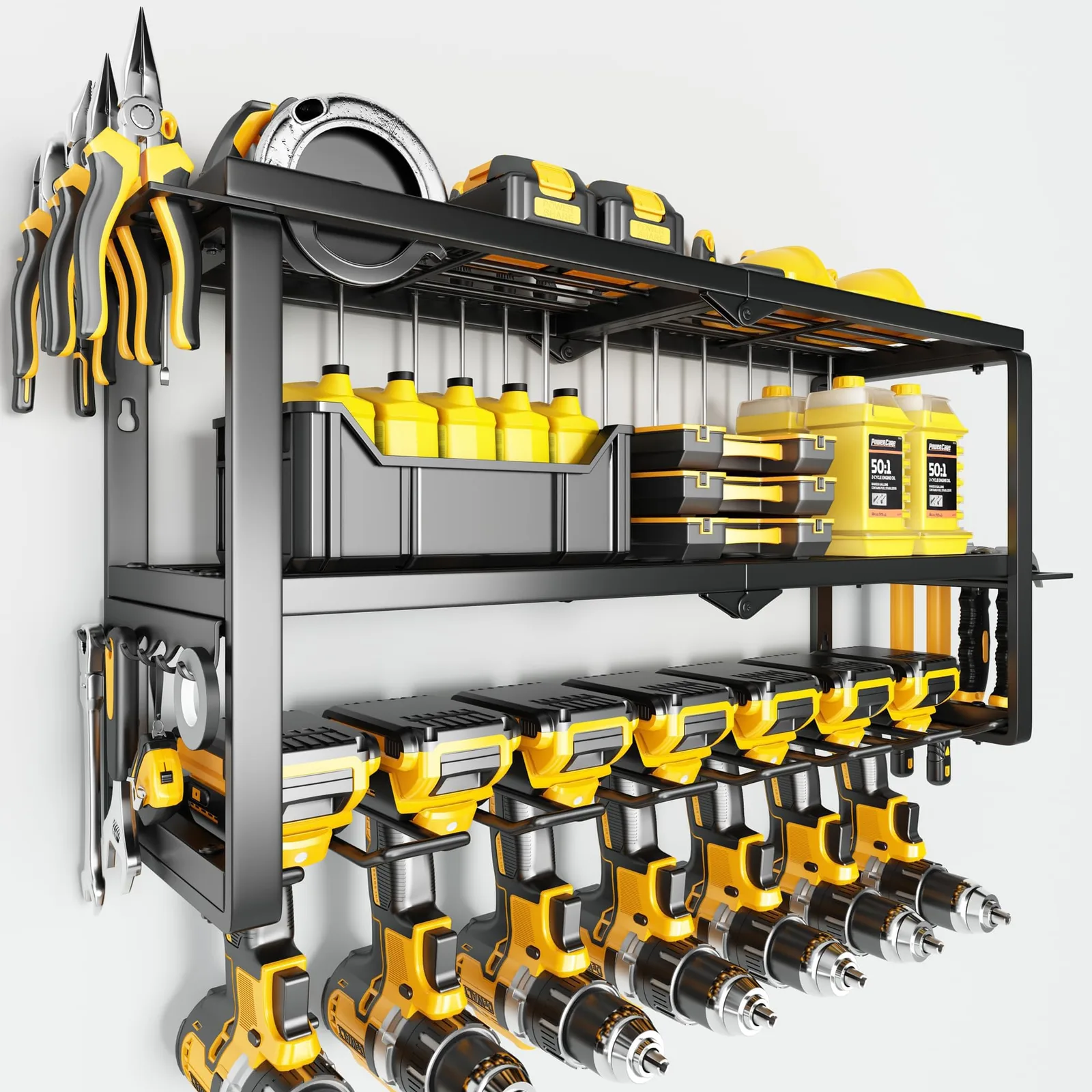
Power Tool Organizer Wall Mount - 300Lbs Load 3 Layers Storage Rack with 7 Drill Holders for Drills Cordless Tools. Heavy Duty Iron Garage Tool Organizer Storage for Workshop Shed Pegboard Basement 7 Slots 3 Layers
Product details
300 lbs Load: The 3 tier tool organizer wall mount is made of heavy compact steel metal for greater weight capacity and durability. After load-bearing testing, the utility racks can support up to 300 pounds on sturdy walls. Easy to Install: Our power tool organizer wall mount includes all necessary mounting hardware and clear instructions for easy installation. refer to the professional installation manual, you can assemble a perfect tool rack wall mount in just a few minutes. Heavy Duty Steel Construction: The power tool organizer is constructed from a high quality powder-coated alloy steel, Its sleek black finish prevents scratching, that is rust-resistant, corrosion-resistant, and scratch-resistant. Versatile Tool Storage: The tool storage can turn your tool messy workbench or wasted wall space into a tidy and efficient workplace, keep all of your power & hand tools in one central location so you can easily find them. extra side slots and hooks allow you to organize more things. Gift for all Occasions: The tool organizer wall mount can be hung in the garage, tool room, workshop, etc. If you're looking for a Father's Day, Christmas or birthday gift, our electric tool holder is a great choice and tailored for men, husbands, or fathers.Gifts for dad who wants nothing. Birthday Gifts for Men. Gifts for men who have everything. Gifts for him. Anniversary gifts for men.
- 300 lbs Load: The 3 tier tool organizer wall mount is made of heavy compact steel metal for greater weight capacity and durability. After load-bearing testing, the utility racks can support up to 300 pounds on sturdy walls.
- Easy to Install: Our power tool organizer wall mount includes all necessary mounting hardware and clear instructions for easy installation. refer to the professional installation manual, you can assemble a perfect tool rack wall mount in just a few minutes.
- Heavy Duty Steel Construction: The power tool organizer is constructed from a high quality powder-coated alloy steel, Its sleek black finish prevents scratching, that is rust-resistant, corrosion-resistant, and scratch-resistant.
- Versatile Tool Storage: The tool storage can turn your tool messy workbench or wasted wall space into a tidy and efficient workplace, keep all of your power & hand tools in one central location so you can easily find them. extra side slots and hooks allow you to organize more things.
- Gift for all Occasions: The tool organizer wall mount can be hung in the garage, tool room, workshop, etc. If you're looking for a Father's Day, Christmas or birthday gift, our electric tool holder is a great choice and tailored for men, husbands, or fathers.Gifts for dad who wants nothing. Birthday Gifts for Men. Gifts for men who have everything. Gifts for him. Anniversary gifts for men.
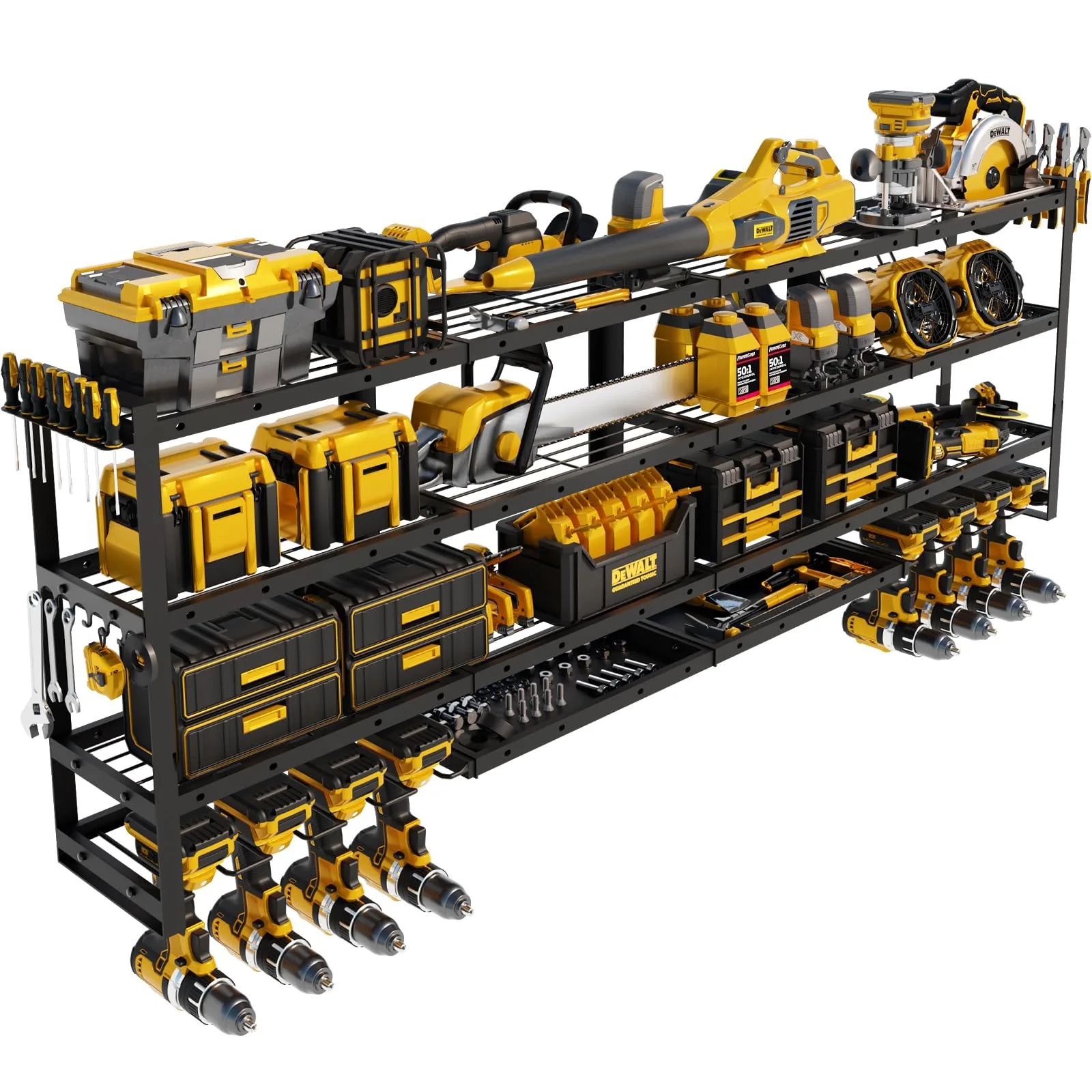
STURDIFLOW XLarge 64''W Power Tool Organizer Wall Mount | Modular&Corner-Fit 820lbs Garage Storage Rack with 8 Cordless Drill Holder | 4-Tier Heavy Duty Utility Shelf for Battery Workshop Organization Hank | 64''Wide, 8-Drill
Product details
✅【THE ULTIMATE GARAGE SOLUTION】 Your setup evolves — so should your tool organizer. Hank is built for serious makers and future-proof garages. It delivers massive storage capacity, smarter tiering, and unmatched modularity to turn chaos into control. ✅【1.6" TALLER SHELVES = BIGGER STORAGE】 More than just more slots — this power tool organizer's two main shelves are 1.6" taller than standard models, giving you the clearance to store larger, bulkier tools with ease. From angle grinders to oversized kits, everything fits — and is easier to reach. ✅【3-IN-1 INSTALL FLEXIBILITY】 Unlike static competitors, Hank adapts to your garage. Choose from straight, L-shaped, or corner-style installation to maximize your wall space — perfect for tight corners, shared walls, or creative setups. One rack, endless fits. ✅【620LBS TESTED | A572Gr50 STEEL】 The xlarge power tool organizer wall mount uses American-grade A572Gr50 high-tensile steel — trusted in bridges and industrial builds. Engineered to hold up to 620 lbs without bending. You’re not just organizing tools — you’re anchoring your whole garage. ✅【FAST INSTALL. FOREVER RELIABLE.】 Pre-drilled for 16” stud spacing, with wall anchors for concrete or brick. Setup takes 15 mins. Enjoy a cleaner, smarter garage that grows with you.
- ✅【THE ULTIMATE GARAGE SOLUTION】 Your setup evolves — so should your tool organizer. Hank is built for serious makers and future-proof garages. It delivers massive storage capacity, smarter tiering, and unmatched modularity to turn chaos into control.
- ✅【1.6" TALLER SHELVES = BIGGER STORAGE】 More than just more slots — this power tool organizer's two main shelves are 1.6" taller than standard models, giving you the clearance to store larger, bulkier tools with ease. From angle grinders to oversized kits, everything fits — and is easier to reach.
- ✅【3-IN-1 INSTALL FLEXIBILITY】 Unlike static competitors, Hank adapts to your garage. Choose from straight, L-shaped, or corner-style installation to maximize your wall space — perfect for tight corners, shared walls, or creative setups. One rack, endless fits.
- ✅【620LBS TESTED | A572Gr50 STEEL】 The xlarge power tool organizer wall mount uses American-grade A572Gr50 high-tensile steel — trusted in bridges and industrial builds. Engineered to hold up to 620 lbs without bending. You’re not just organizing tools — you’re anchoring your whole garage.
- ✅【FAST INSTALL. FOREVER RELIABLE.】 Pre-drilled for 16” stud spacing, with wall anchors for concrete or brick. Setup takes 15 mins. Enjoy a cleaner, smarter garage that grows with you.
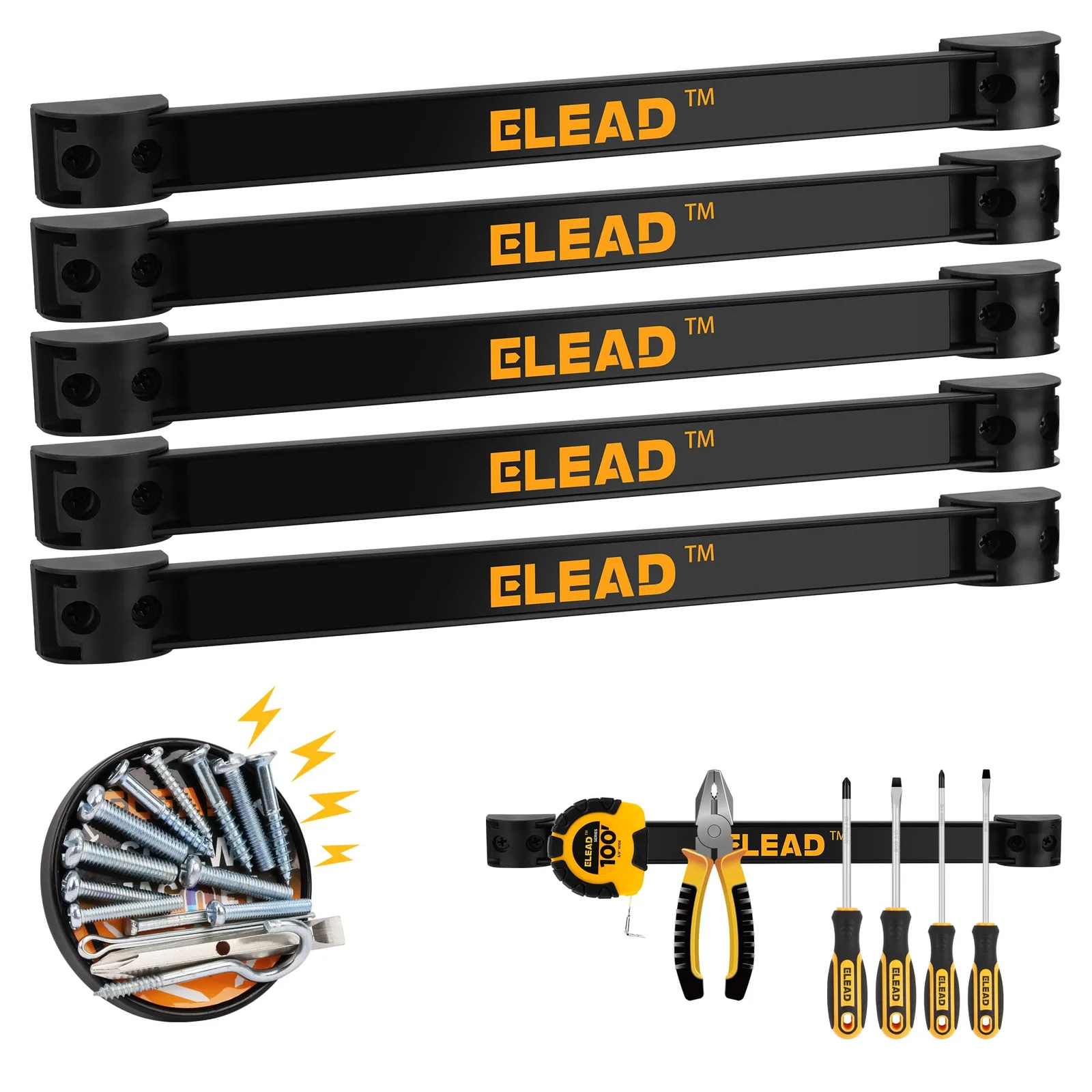
ELEAD 6-Piece 12" Magnetic Tool Holder Storage Organizer - Wall Mount Rack Garage Organization Power Magnet Hanger Workbench Board Slatwall Van Organizers Mounted Hanging Strip Magnetic 6-Piece
Product details
ROBUST CONSTRUCTION - Fabricated from high-quality alloy steel, the Magnetic Tool Holder ensures superior sturdiness. The potent magnet supports up to 10 lbs, perfect for your tool storage. USER-FRIENDLY SETUP - This wall-mounted organizer includes mounting screws, guaranteeing straightforward installation. It's a compact solution for garages, workbenches, or kitchens, minimizing clutter on counters and drawers. PRACTICAL UTILITY – Acting as a magnetic trouser clip, it secures to your belt, holding screws, bits, and tools for easy access and retrieval. POWERFUL ORGANIZATION - Say goodbye to messy tool boxes and welcome streamlined organization with this Magnetic Tool Holder. It can comfortably house your pliers, wrenches, and screwdrivers, making your workbench more accessible and efficient. FLEXIBLE DESIGN - Suitable for any slatwall, this 6-piece organizer is an excellent choice for van hangers or shelving units. The magnetic strips also function as a handy key holder.
- ROBUST CONSTRUCTION - Fabricated from high-quality alloy steel, the Magnetic Tool Holder ensures superior sturdiness. The potent magnet supports up to 10 lbs, perfect for your tool storage.
- USER-FRIENDLY SETUP - This wall-mounted organizer includes mounting screws, guaranteeing straightforward installation. It's a compact solution for garages, workbenches, or kitchens, minimizing clutter on counters and drawers.
- PRACTICAL UTILITY – Acting as a magnetic trouser clip, it secures to your belt, holding screws, bits, and tools for easy access and retrieval.
- POWERFUL ORGANIZATION - Say goodbye to messy tool boxes and welcome streamlined organization with this Magnetic Tool Holder. It can comfortably house your pliers, wrenches, and screwdrivers, making your workbench more accessible and efficient.
- FLEXIBLE DESIGN - Suitable for any slatwall, this 6-piece organizer is an excellent choice for van hangers or shelving units. The magnetic strips also function as a handy key holder.