Yost M7WW Review: Bench Fit, Mounting and Limitations
Check the Yost M7WW vise dimensions, wooden jaw capacity, bench mounting needs, quick release and practical limitations before buying.
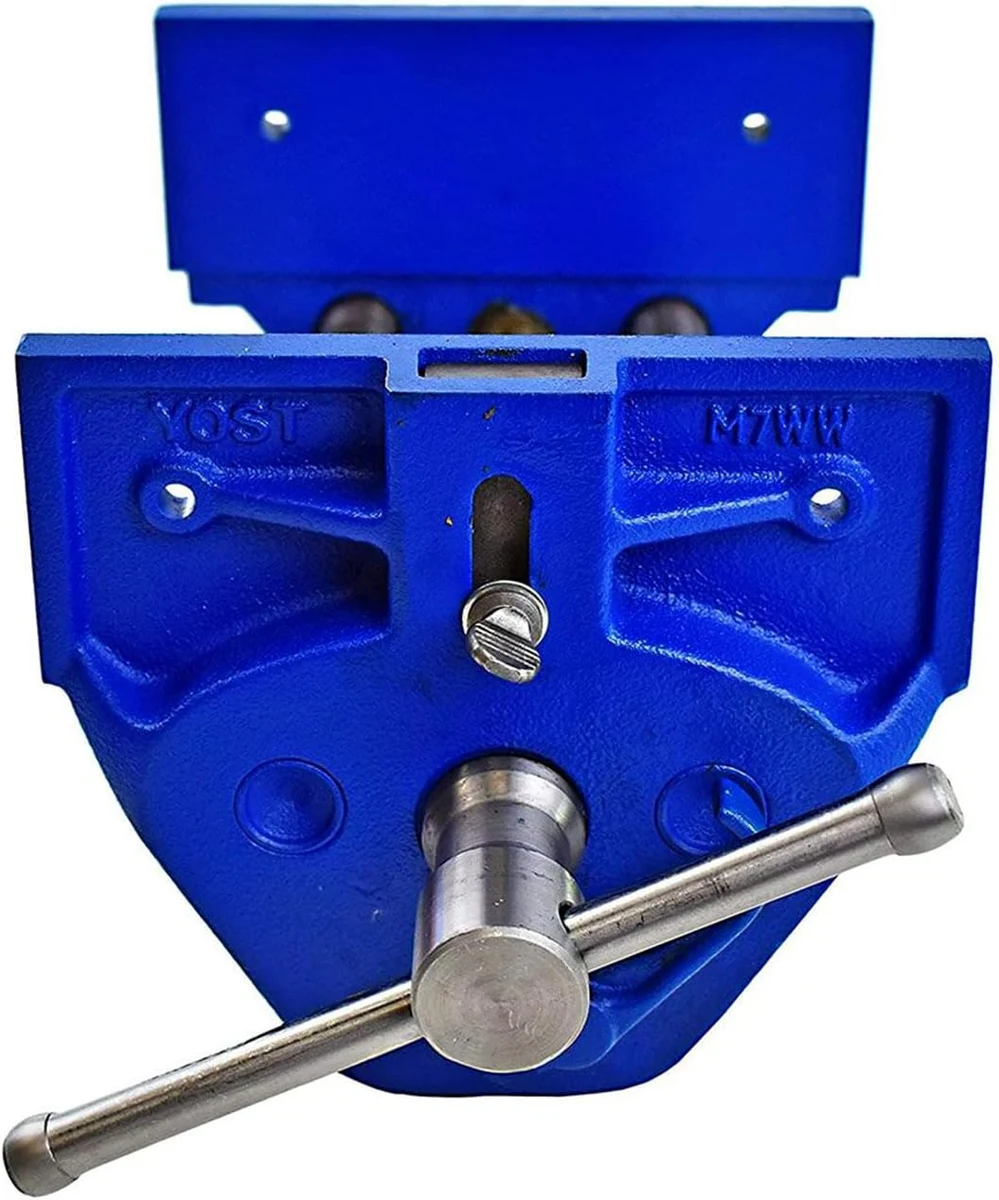
The Yost M7WW makes sense for a permanent woodworking bench when you want quick changes between workpiece sizes and can provide a solid mounting surface. Its seven-inch jaws are a useful size for small furniture parts. The purchase becomes less attractive if your bench has a thin overhang, obstructing drawers, or no room beneath the front edge: solving those problems can take more work than fitting the vise itself.
PRODUCTS IN THIS GUIDE
Yost M7WW 7-Inch Rapid Action Woodworking Vise
For a permanent woodworking bench with appropriate mounting support. Check wooden-face thickness and under-bench clearance before purchase.
Check price on Amazon for Yost M7WW 7-Inch Rapid Action Woodworking Vise (opens in a new tab)Research review — October 27, 2026. This assessment uses Yost's specifications, its model drawing, and the identified Amazon listing. We have not tested clamping force, racking, long-term wear, or the quick-release mechanism. Product photographs are Amazon listing images, not photographs of a review sample. As an Amazon Associate, we earn from qualifying purchases.
Check the Yost M7WW on Amazon ↗.
What you are buying
| Detail | M7WW specification | What to check on your bench |
|---|---|---|
| Jaw width | 7 inches | Space beside legs and other fixtures |
| Maximum jaw opening | 8 inches | Finished capacity after adding wooden faces |
| Throat depth | 3 inches | How deeply a board can sit between the jaws |
| Body | Cast iron | Adequate support under the benchtop |
| Adjustment | Screw with quick-release lever | Access to the lever and handle throughout travel |
These figures come from Yost's M7WW product page. The model name matters. M7WW, M9WW, 7WW and F9WW are not interchangeable descriptions of one vise. In particular, a front-vise hardware kit may require you to build wooden jaws, while this model has an assembled metal jaw structure.
Do not interpret the tensile-strength figure in the product description as measured clamping pressure. It describes the material, not the force you should apply to a board or the resistance of your particular installation.
Measure before ordering
Start with a cross-section sketch of the front edge of your bench. Include the top thickness, apron, nearest leg, any drawer box, and the clear underside area. Then compare that drawing with the M7WW model layout. Use dimensions from the current instructions or the delivered unit before drilling final holes.
The layout drawing gives a 7-7/8-inch opening, whereas the current product page rounds it to eight inches. For a close-fitting workpiece, use the drawing and measure the delivered vise instead of relying on the rounded figure. The layout also calls for a shim to a total 2-3/8-inch mounting thickness when the benchtop is thinner than that. Check that mounting section against your actual top and apron before selecting hardware.
The handle needs room to rotate without hitting your knees, cabinet doors, or a nearby machine. The moving assembly also needs clearance underneath the top. A vise that fits when closed may interfere with a drawer when extended. Mock up that travel with a strip of cardboard rather than assuming that the benchtop overhang is sufficient.
A thin top can need blocking, but there is no universal spacer thickness that makes every bench suitable. The mounting arrangement must support the vise and the loads from your work. Include appropriate mounting hardware, any reinforcement, and wooden faces in your shopping plan. If those additions force a substantial bench rebuild, compare that total project with another mounting style in our woodworking vise guide.
How much opening remains with wooden jaws?
The listed eight-inch opening is not the same as the usable opening after you add protective liners. As a planning example, two half-inch wooden faces consume approximately one inch of space between the original jaw surfaces. That would leave roughly seven inches before allowing for the actual installation. Measure your finished vise rather than treating that example as a guaranteed capacity.
Wider wooden faces can support a long board more comfortably, but a face that extends far beyond the metal jaws does not turn the vise into a wider iron casting. Position work sensibly and use additional support for long stock. A board hanging far off one side places different demands on the assembly from a small part centered between the jaws.
Our vise jaw pad and face guide explains why permanent wooden faces and magnetic soft jaws serve different purposes.
Is the quick release worth paying for?
It is most useful when you repeatedly switch from thin boards to thicker assemblies. Sliding the movable jaw most of the way into position saves turning the screw through the full distance every time. You still finish the grip with the screw; quick release is an adjustment feature, not a powered clamp.
For someone who spends most sessions holding similarly sized stock, the advantage is smaller. For a shared bench that alternates between edge work, drilling, and small assemblies, convenient adjustment can be a better reason to buy than a larger jaw-width number.
Before using a new vise on a valuable part, practice engagement on scrap and follow the manufacturer's operating instructions. Stop if the screw or release behaves inconsistently. Do not compensate for slipping engagement with a longer handle or excessive force.
The limitations that matter in daily work
It occupies a permanent position. A clamp-on vise is easier to move between temporary work surfaces. The M7WW's installation is better justified on a bench whose position and front edge are already settled.
Jaw faces are part of the setup. Bare metal is not the surface we would choose against finished wood. Build the protection into your plan instead of discovering the need after the vise arrives.
Long work needs support. The vise grips the work at one location. An unsupported board can sag or become awkward to control during edge work. A support at the other end may contribute more to a comfortable setup than buying a larger vise.
We cannot rank its resistance to racking from specifications. Guide rails and an off-center load are easy to see in a drawing; comparative stiffness requires a controlled test. We do not claim that this model outperforms another vise in that test.
Delivery and setup checks
Inspect the casting, handle, guide rods, lever, and included instructions while the packaging is available. Check that the mechanism travels and engages as described before committing to your final mounting holes. Resolve missing or damaged parts with the seller or manufacturer rather than modifying a faulty mechanism.
After mounting, check that nothing collides through the intended operating range. Fit your wooden faces with recessed fasteners and test on scrap. Make sure a fastener head cannot contact the work when the faces wear or compress. Keep the initial setup conservative until you understand the mechanism.
Questions buyers ask
Does the M7WW include a bench?
No. The Amazon listing is for the vise. Listing photographs and workshop examples should not be read as a complete bench package.
Will it work on a portable folding bench?
Do not assume so. Check the bench manufacturer's mounting and load guidance as well as the vise instructions. A purpose-built fixed bench is the clearer application; a lightweight top can require a different vise format.
Is this a good substitute for a metalworking vise?
Choose it around woodworking tasks and the manufacturer's instructions. A woodworking face vise should not be bought on the assumption that it is an anvil or a general-purpose hammering station.
Should I buy the larger M9WW instead?
Only if your actual work and bench need the extra capacity. A larger vise also takes more space and support. First measure the parts you most often clamp, including jaw-face thickness, and compare the installation drawings.
Our verdict: shortlist the M7WW when its assembled jaw format, quick release, and mounting requirements suit your permanent bench. Spend the time on fit and faces; those decisions have a direct effect on whether the vise is useful. View the exact M7WW listing ↗.
Yost M7WW 7-Inch Rapid Action Woodworking Vise
Check price on Amazon for Yost M7WW 7-Inch Rapid Action Woodworking Vise (opens in a new tab)Explore the recommendations.
Check Amazon for current product details, available options, and pricing.
Yost M7WW 7-Inch Rapid Action Woodworking Vise
Product details
For a permanent woodworking bench with appropriate mounting support. Check wooden-face thickness and under-bench clearance before purchase.
- 7-inch jaw width
- 8-inch published opening before added faces
- Quick-release adjustment lever