Best Air Filtration Systems for Workshops
Compare workshop air-filtration systems by airflow, room coverage, filter stages, noise, controls, and replacement-filter availability.
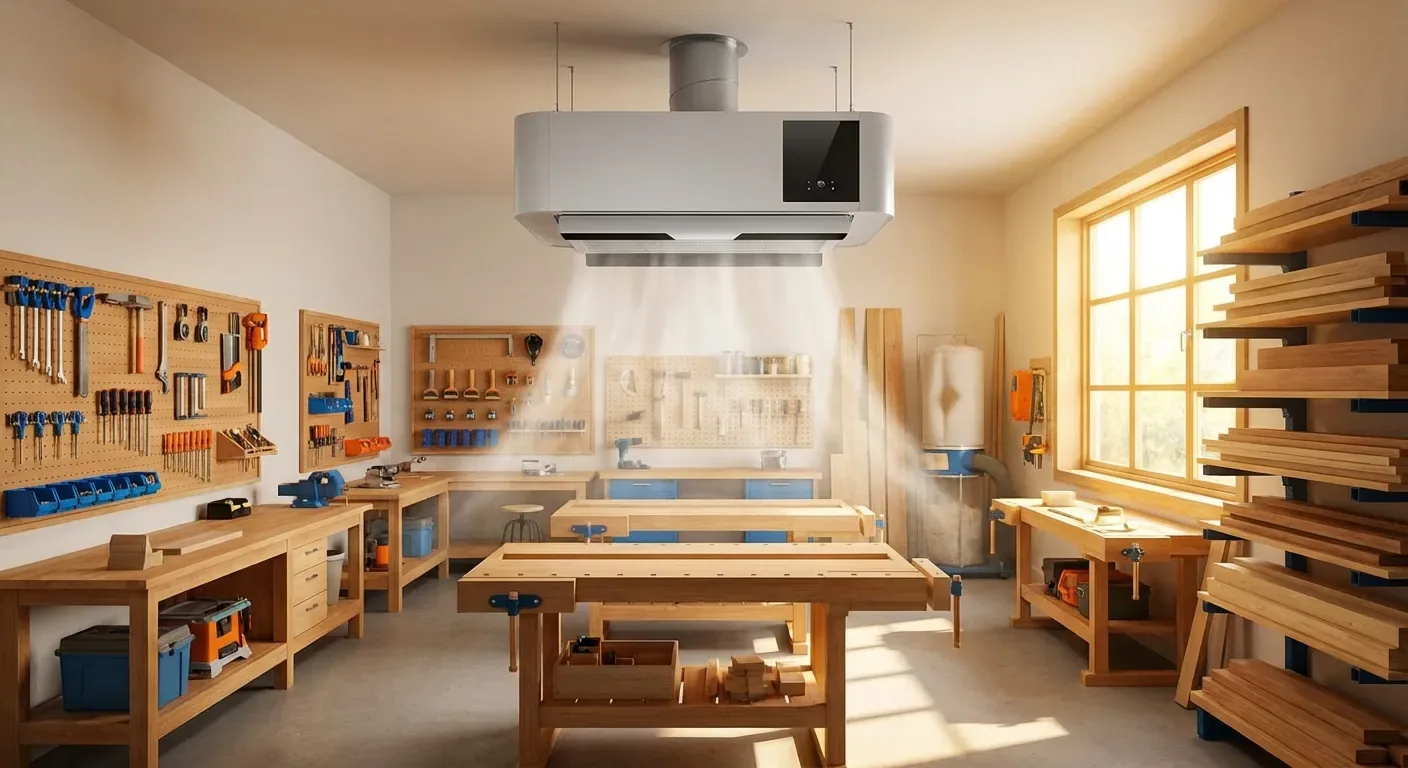
Woodworking is a rewarding craft, but it produces a silent byproduct that can be hazardous to your long-term health: fine sawdust. While your shop vac or dust collector handles the large chips at the source, it is the microscopic particles—the ones you can't see—that linger in the air for hours. These particles are small enough to bypass your body's natural defenses and settle deep in your lungs. A dedicated workshop air filtration system is the final line of defense, designed to cycle the air in your room multiple times per hour and scrub it clean of these invisible threats.
PRODUCTS IN THIS GUIDE
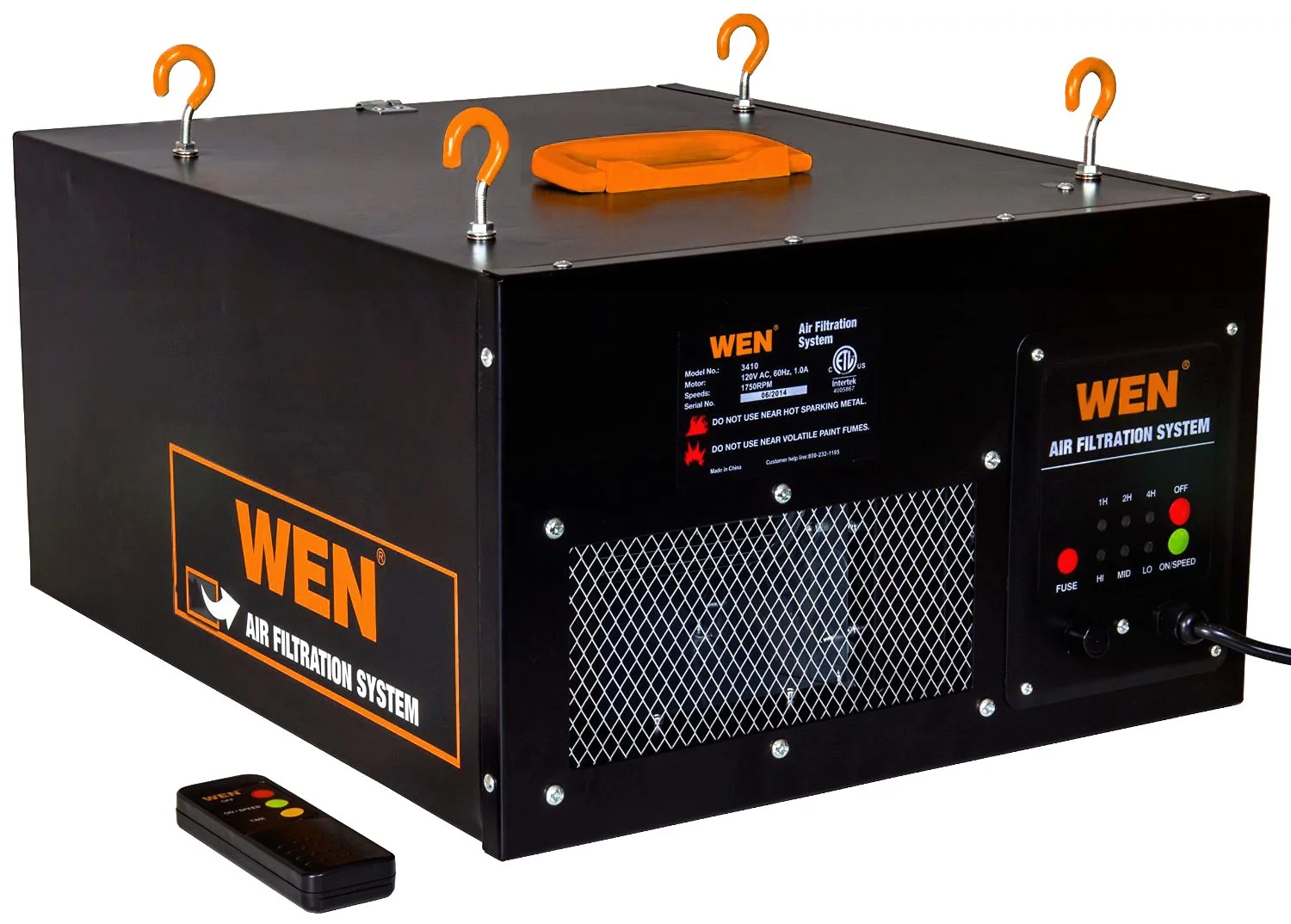
WEN 3410 Air Filtration System
WEN 3410 review with recent Amazon feedback, room-volume calculations, filter costs, reliability considerations, and realistic dust-control limits.
Check price on Amazon for WEN 3410 Air Filtration System (opens in a new tab)Choosing the right air filtration system involves more than just picking the largest unit you can find. You need to consider the volume of your shop, the types of projects you undertake, and the noise levels you can tolerate. A system that is too small will fail to clear the air effectively, while one that is too large might be an unnecessary drain on your electricity and shop space. In this guide, we evaluate systems based on their Cubic Feet per Minute (CFM) ratings, filtration efficiency (micron levels), and ease of maintenance to ensure you find a model that fits your specific workflow.
Our selection criteria focused on real-world performance and reliability. We looked for units that offer multi-speed settings, allowing you to run them on high during heavy sanding and on a quieter low setting while you're assembling projects. We also prioritized systems with remote controls and programmable timers, which allow you to leave the unit running for an hour after you've finished for the day, ensuring the air is pristine when you return the next morning. These features, combined with high-quality filter availability, are what define the best workshop air filtration systems on the market today.
Table of Contents
- Quick Comparison Table
- Best Overall: WEN 3410 3-Speed Air Filtration System
- Best Industrial Power: WEN 3417 Industrial Strength System
- Best Premium Performance: JET AFS-1000B System
- Best for Small Shops: SHOP FOX W1830 Hanging Filter
- Best Heavy-Duty Output: WEN AF1270 3-Speed System
- How We Evaluated the Systems
- Workshop Air Filtration Buying Guide
- Frequently Asked Questions
Quick Comparison Table
| Product Name | Best For |
|---|---|
| WEN 3410 3-Speed Air Filtration System ↗ | Most Home Workshops |
| WEN 3417 Industrial Strength System ↗ | High-Volume Dust Production |
| JET AFS-1000B Air Filtration System ↗ | Professional Reliability |
| SHOP FOX W1830 Hanging Air Filter ↗ | Compact Spaces & Benchtop Use |
| WEN AF1270 Heavy-Duty System ↗ | Large Multi-Car Garages |
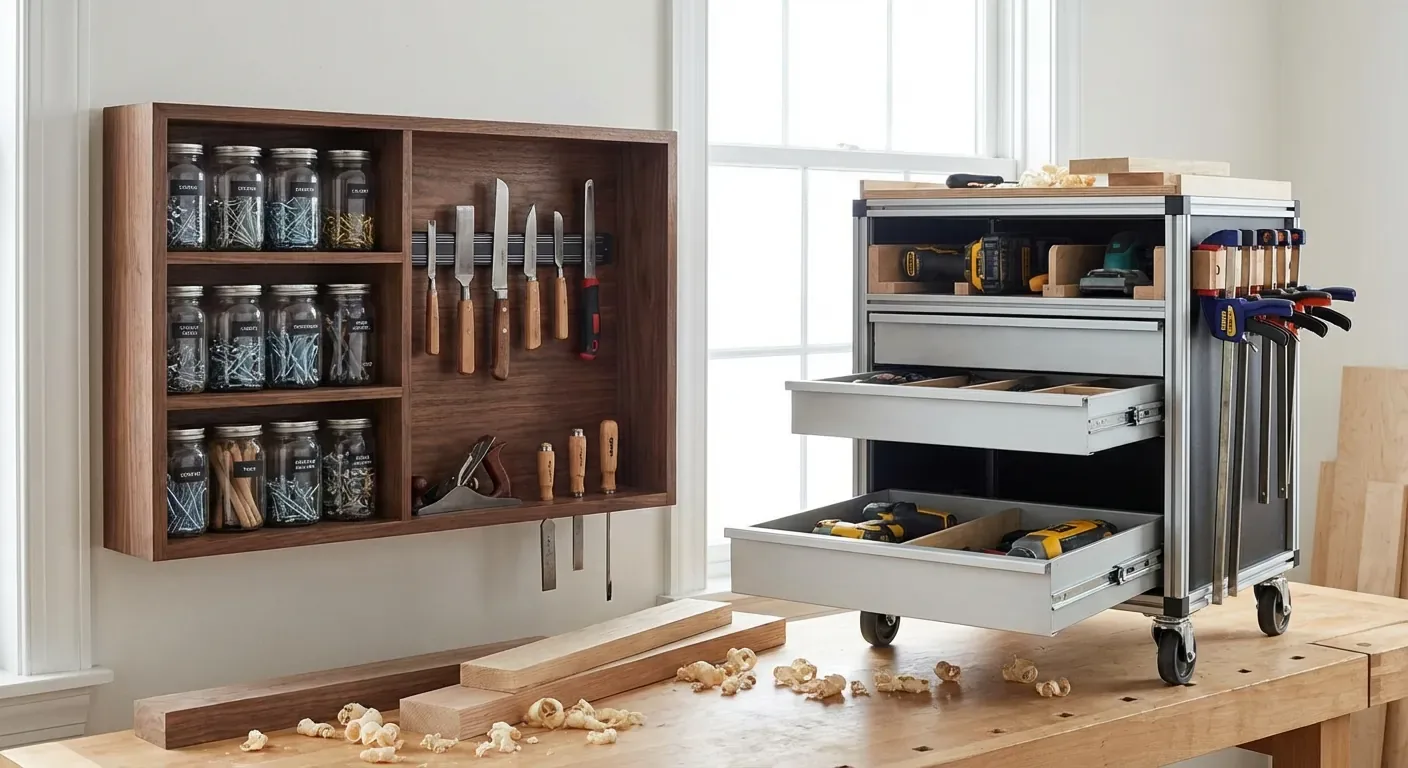
WEN 3410 Air Filtration System
Check price on Amazon for WEN 3410 Air Filtration System (opens in a new tab)Best Overall: WEN 3410 3-Speed Air Filtration System
The WEN 3410 is widely considered the gold standard for the average hobbyist woodworker. It strikes an incredible balance between price, footprint, and performance, making it accessible for those working in single or double-car garages. With a maximum airflow of 400 CFM, it is capable of cycling the air in a 400-square-foot shop approximately 7.5 times per hour. This frequency is critical for maintaining an environment where fine dust doesn't have the chance to settle on every surface or enter your respiratory system.
One of the standout aspects of the WEN 3410 is its ease of installation and use. It comes with the necessary hardware for ceiling mounting, which is the ideal position for capturing rising dust clouds. The included remote control is a game-changer, allowing you to toggle between the 300, 350, and 400 CFM settings from across the room. This is particularly useful when you transition from a low-dust activity like hand-planing to a high-dust activity like orbital sanding and need an immediate boost in air scrubbing power.
Furthermore, the filtration system uses a dual-filter approach. The outer 5-micron pre-filter catches the larger particles, preventing the inner 1-micron filter from clogging prematurely. This design extends the life of the more expensive inner filter and ensures the unit maintains consistent airflow over time. Replacement filters for WEN units are also among the most affordable and widely available on the market, which lowers the long-term cost of ownership significantly compared to boutique brands.
WEN 3410 3-Speed Remote-Controlled Air Filtration System (300/350/400 CFM), Basic w/ RF Remote (400 CFM) , Black Basic w/ RF Remote (400 CFM) Air Filtration System ↗
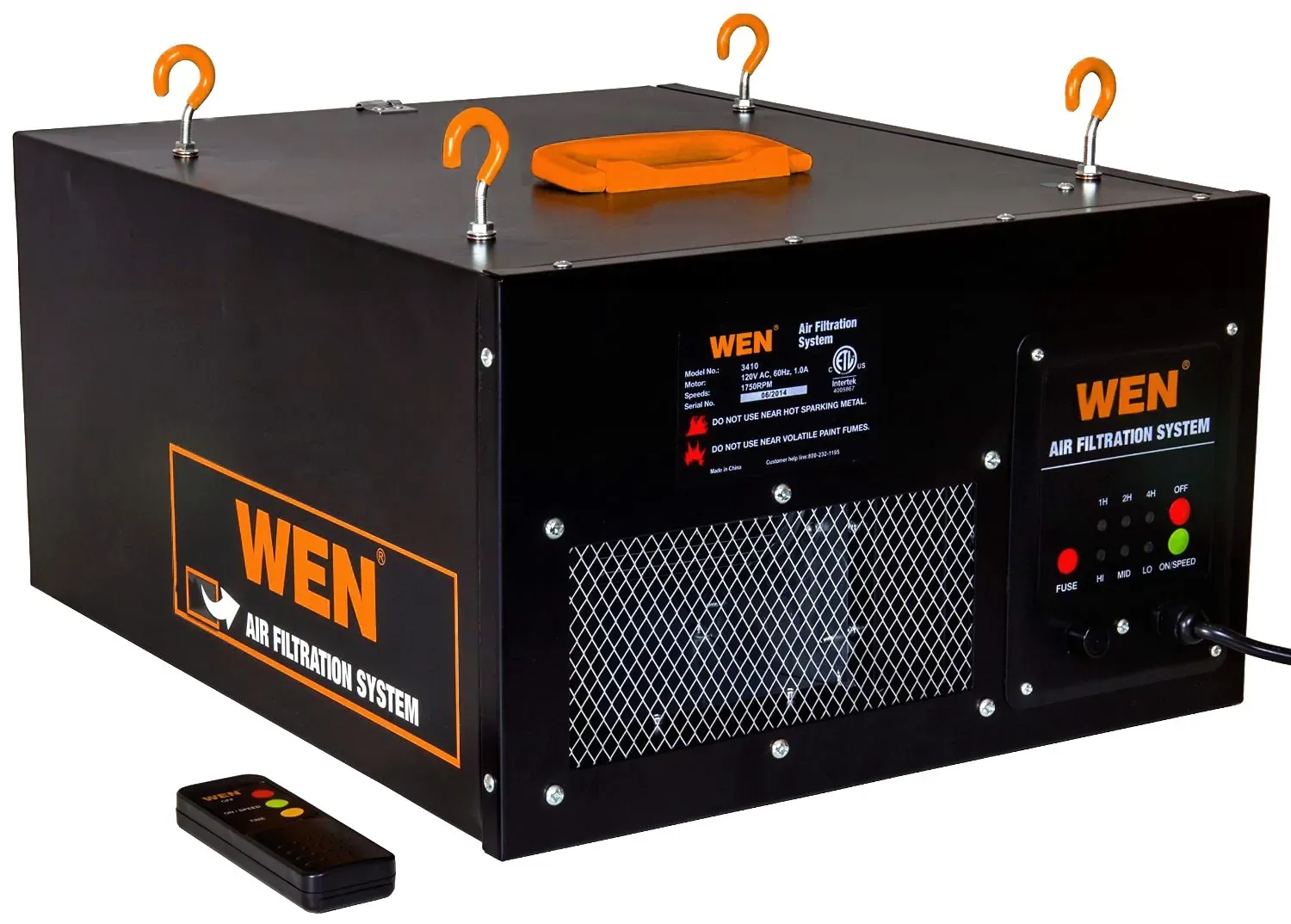
- Includes a 1-micron filter and a 5-micron pre-filter, both of which can be easily replaced
- Dimensions – 17” L x 20.5” W x 10” H | Electrical Requirements – 120V, 60 Hz, 1A | Air flow – 300/350/400 cubic feet per minute | Cover rooms up to – 400 sq ft. | Noise rating – 50 to 60 dB
- Programmable timer automatically shuts unit off after set number of minutes
I recommend the WEN 3410 for hobbyists and DIYers who operate in standard garage-sized workshops. It is the best overall pick because it provides professional-level filtration (down to 1 micron) at a price point that is hard to beat. The unit is best for those who need a reliable, "set it and forget it" solution that doesn't require a complex setup.
Standout features include the programmable timer, which can be set for 1, 2, or 4 hours. This allows you to leave the shop immediately after a project while the unit continues to clean the air, automatically shutting off once the cycle is complete. The 1/6 HP motor is surprisingly quiet, meaning it won't drown out your music or conversation while it's running on the lower settings.
The only real drawback is that it might struggle in very large shops (over 500 sq. ft.) or shops with exceptionally high ceilings. In those cases, the 400 CFM might not cycle the air fast enough to keep up with heavy machinery. Compared to the more expensive JET models, the housing is slightly more utilitarian, but functionally, it performs its core task exceptionally well.
Best Industrial Power: WEN 3417 Industrial Strength System
For woodworkers who produce a higher volume of dust—perhaps through frequent use of a thickness planer or a lathe—the WEN 3417 offers a significant step up in power. Moving up to a maximum of 1044 CFM, this unit is designed for larger spaces where a smaller filter would simply be overwhelmed. It utilizes a more powerful 1/3 HP motor to pull air through a larger filter surface area, which not only increases the cleaning speed but also allows the unit to operate more efficiently in dusty environments.
The industrial-strength designation isn't just marketing; the 3417 is built to handle the rigors of a busy shop. It features a heavy-duty steel housing that resists vibration and protects the internal components from the bumps and bruises common in a working environment. Like its smaller sibling, it offers a three-speed range (556, 702, and 1044 CFM), giving you the flexibility to match the filtration speed to the task at hand. This versatility is essential for managing noise levels during different phases of a project.
Maintenance on the 3417 is streamlined through a tool-free filter replacement system. When you are working in a high-production environment, you don't want to spend twenty minutes with a screwdriver just to swap out a dirty pre-filter. The clips on the 3417 allow for a 30-second swap, which encourages regular maintenance and keeps the unit running at peak performance. This focus on user-friendliness makes it a favorite for those who value their time as much as their lung health.
The WEN 3417 is my top recommendation for serious enthusiasts and semi-professionals with medium-to-large workshops. If you find that your current small filtration unit leaves a fine layer of dust on your workbenches by the end of the day, this 1044 CFM powerhouse is the solution. It is best for shops ranging from 600 to 1,000 square feet where high-volume air movement is required.
The standout feature is the sheer volume of air it moves relative to its price. Achieving over 1,000 CFM at this price point is rare. Additionally, the 1-micron inner filter ensures that even the most dangerous fine particles are trapped. The remote control and timer settings (1h, 2h, 4h) are included, providing the same convenience found in the smaller 3410 model but with double the cleaning capacity.
One consideration is the size and weight; at over 50 pounds, you will need a sturdy ceiling joist or a dedicated mounting bracket to hang it safely. It is also noticeably louder on its highest setting than smaller units, which is a trade-off for the increased airflow. However, compared to other 1000+ CFM units, it remains one of the most cost-effective ways to achieve industrial-grade air quality.
Best Premium Performance: JET AFS-1000B System
The JET AFS-1000B is often cited as the original high-performance air filtration system that set the standard for the industry. While other brands have followed its design, JET remains a favorite among professionals due to its exceptional build quality and the reliability of its motor. This unit is designed for longevity, featuring a robust internal fan and a housing that is engineered to minimize noise and vibration. For a professional shop where the unit might run 8 to 10 hours a day, the durability of the JET motor is a significant advantage.
Performance-wise, the AFS-1000B provides a consistent 1044 CFM on high, 702 CFM on medium, and 556 CFM on low. What sets it apart is the quality of the filtration media. JET filters are often rated more conservatively and perform exceptionally well at capturing 1-micron particles right out of the box. The unit is also designed with an "easy-grip" handle for those who prefer to use it as a portable floor unit, though ceiling mounting remains the most effective way to utilize its power.
Another premium touch is the design of the remote control. Unlike some budget remotes that require a direct line of sight to the sensor, the JET remote uses an infrared system that is highly responsive even in cluttered shops. The timer functionality is also more granular, offering settings that allow for precise control over post-work cleaning cycles. This attention to detail is why many woodworkers are willing to pay the premium for the JET name.
I recommend the JET AFS-1000B for professional woodworkers or hobbyists who want the "buy once, cry once" option. It is best for those who prioritize brand reliability, long-term parts availability, and a slightly quieter operation at high speeds. It excels in professional environments where equipment downtime is not an option.
The standout feature is the overall engineering of the airflow path. The unit is designed to be exceptionally efficient, meaning it moves its rated CFM without straining the motor, which leads to a longer lifespan. The filters are also high-grade, with the inner pocket filter offering a large surface area for maximum dust retention without sacrificing airflow.
The primary drawback is the price; it is significantly more expensive than the WEN 1000 CFM equivalent. Some users might find it difficult to justify the extra cost when the specs look similar on paper. However, when you consider the vibration-dampening construction and the track record of JET's customer support, the value becomes clearer for a long-term shop investment.
Best for Small Shops: SHOP FOX W1830 Hanging Filter
Not every woodworker has a sprawling garage. For those working in basement nooks, small sheds, or dedicated corners of a larger room, the SHOP FOX W1830 is an ideal solution. This unit is significantly more compact than the standard 1000 CFM models, yet it still packs a 1/8 HP motor capable of moving 260 CFM. While that may sound low compared to industrial units, it is perfectly sized for a small 10x10 or 12x12 shop, providing the necessary air changes without creating a wind tunnel effect.
The W1830 is unique because it is designed specifically for versatility. It can be hung from the ceiling using the included chains, but its small footprint also makes it suitable for benchtop use near a specific dust-producing machine, like a scroll saw or a small sander. This "point-of-origin" filtration can be incredibly effective when you don't have the space for a massive ceiling-mounted system.
Despite its smaller size, SHOP FOX didn't skimp on the essential features. It still includes a remote control and a timer with 1, 2, and 4-hour settings. The filtration is also impressive for its class, utilizing a 5-micron outer filter and a 1-micron inner filter. This ensures that even in a small space, you are getting the same level of microscopic cleaning that the larger units provide, just scaled down for a smaller volume of air.
The SHOP FOX W1830 is my top pick for apartment dwellers, basement woodworkers, or anyone with a shop under 250 square feet. It is also an excellent "secondary" unit for a large shop to place directly above a sanding station. It is best for those who need a lightweight, easy-to-install solution that won't overwhelm a small electrical circuit.
Standout features include its portability and low weight (about 31 lbs), making it much easier for a single person to install on a ceiling compared to the 50lb+ industrial units. The 260 CFM is perfectly tuned for small spaces, ensuring the air is cleaned without creating excessive noise that can be a nuisance in residential settings.
The main drawback is that it is strictly for small spaces. If you try to use this in a two-car garage, you won't notice much of a difference in air quality because it simply cannot move enough volume. Additionally, the filter size is proprietary to this smaller form factor, so you'll need to ensure you keep a stock of SHOP FOX-compatible filters on hand.
Best Heavy-Duty Output: WEN AF1270 3-Speed System
When 1000 CFM isn't enough, the WEN AF1270 enters the fray. This is one of the most powerful ambient air cleaners available for the consumer market, boasting a massive 1270 CFM on its highest setting. Designed for large professional shops or three-car garages, this unit is built to move a staggering amount of air quickly. If you are running multiple machines simultaneously or doing heavy sanding on large furniture pieces, the AF1270 provides the high-volume scrubbing necessary to keep the air clear.
The AF1270 features a reinforced steel cabinet and a high-efficiency motor that is tuned for maximum output. Despite its power, it maintains the same user-friendly features that WEN is known for, including a three-speed remote and a programmable timer. The extra CFM allows this unit to handle shops up to 1200 square feet, ensuring that even the furthest corners of the room receive adequate air circulation.
One of the benefits of such a high CFM rating is the speed of recovery. After a particularly dusty operation, the AF1270 can clear the visible haze in a room in a matter of minutes. This is a massive advantage for woodworkers who move quickly between different stages of a project and don't want to wait an hour for the air to clear before they can start finishing or painting.
I recommend the WEN AF1270 for anyone with a large workshop (over 800 sq. ft.) or professionals who work with high-dust materials like MDF or exotic hardwoods. It is the best choice for those who want the maximum possible airflow without jumping into the much more expensive world of specialized industrial HVAC filtration systems.
The standout feature is clearly the 1270 CFM capacity. At this flow rate, you can achieve the recommended 6-8 air changes per hour even in very large spaces. The dual-filter system is also scaled up here, providing more surface area which means the filters clog less quickly than smaller units doing the same amount of work.
The drawback to this much power is the noise and the footprint. It is a large unit that requires significant ceiling space and a very secure mounting solution. It also draws more power, so you'll want to ensure it’s not on the same circuit as a heavy-duty table saw to avoid tripping breakers. Compared to the 1000 CFM models, it’s a beast, but for the right shop, it’s an absolute game-changer.
How We Evaluated the Systems
This comparison uses manufacturer airflow, filter, noise, control, and room-size specifications together with recurring themes in owner feedback. We have not independently measured each unit’s airflow, sound level, particle removal, remote range, or timer accuracy.
We compared calculated air changes per hour, filter stages and replacement availability, published noise figures, speed settings, timer controls, mounting requirements, and long-term maintenance. Manufacturer CFM is a useful planning number, but installed performance changes as filters load and as the room layout affects circulation.
Workshop Air Filtration Buying Guide
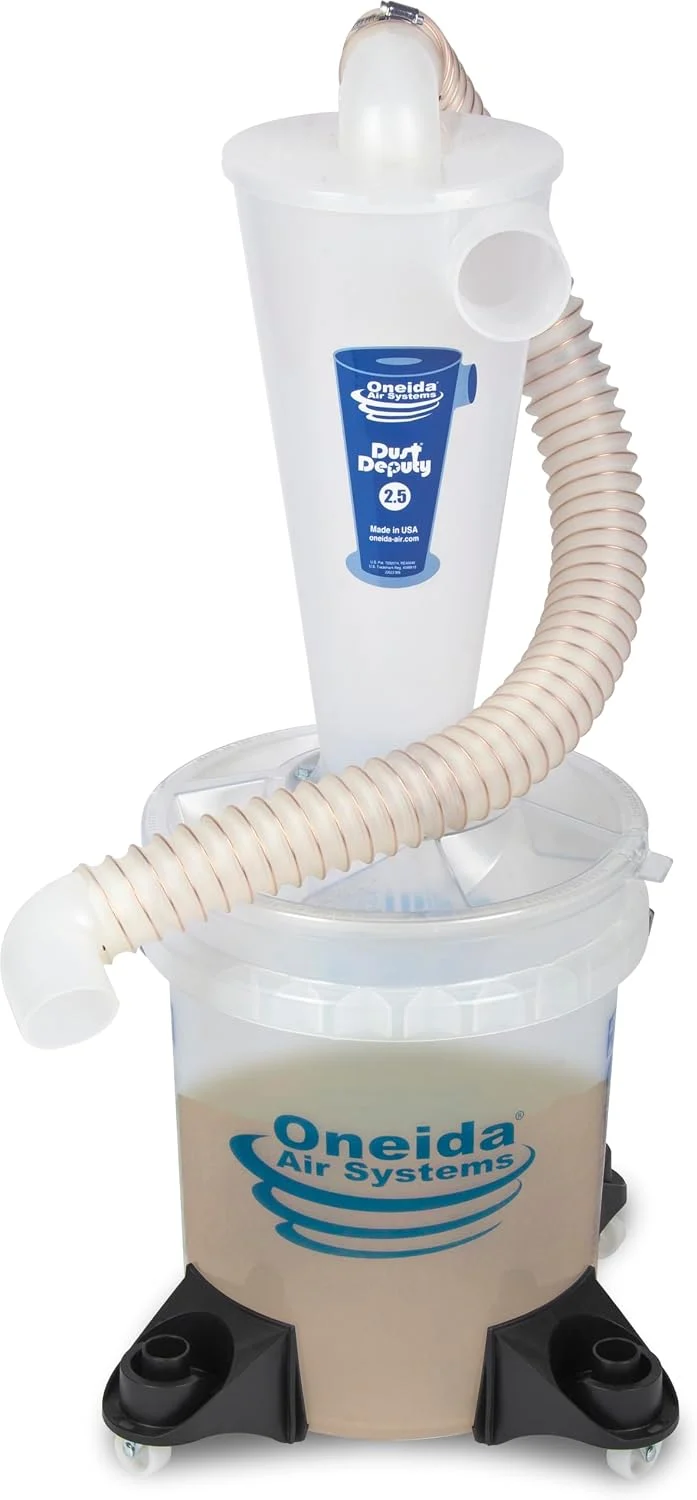
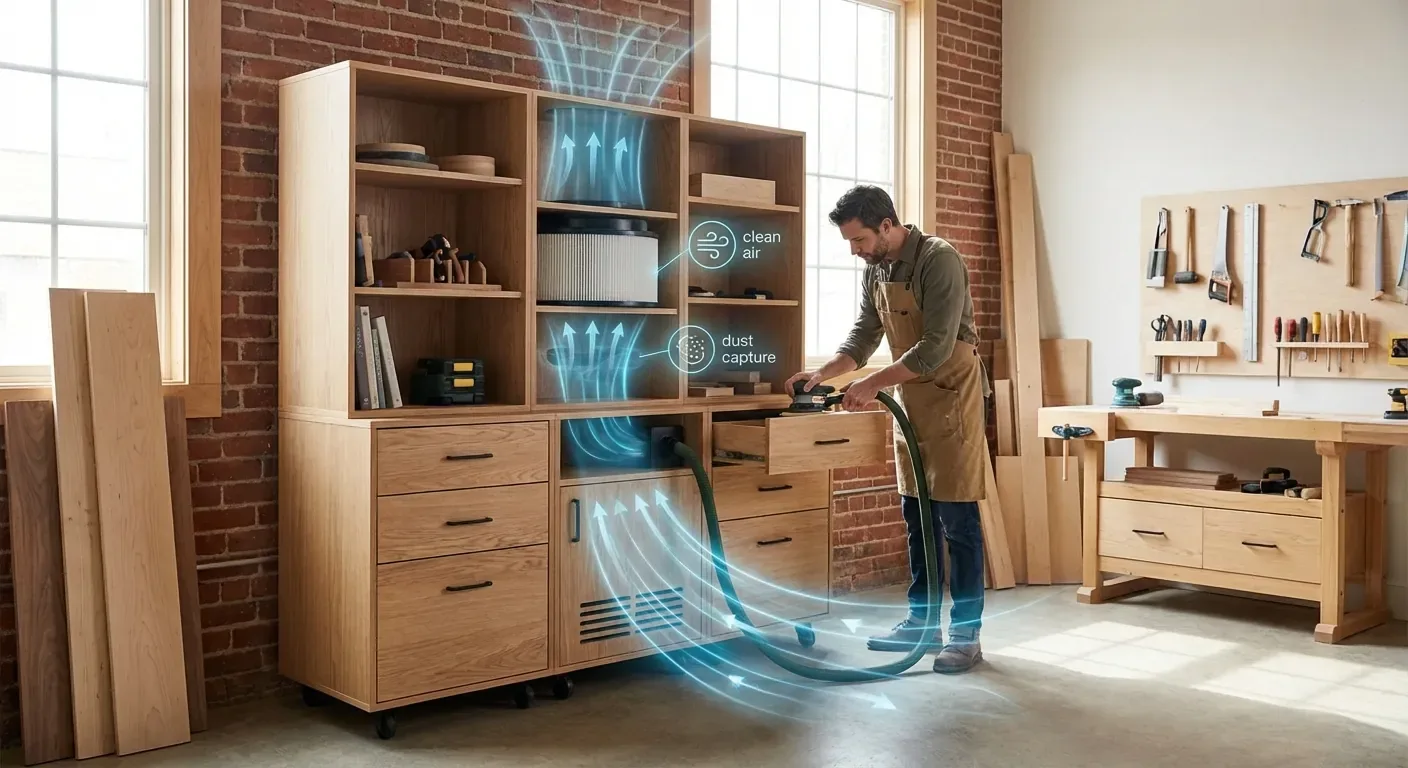
Ambient filtration handles particles that source capture misses. Plan the source-capture side with the complete woodworking dust collection guide, calculate a ducted system with the dust collector sizing tool, or compare shop vacs for fine wood dust for sanders and other handheld tools.
Measure the usable room volume: length × width × height. For a planning comparison, nominal air changes per hour equal published CFM × 60 ÷ room volume. A 20-by-20-by-8-foot room has a volume of 3,200 cubic feet; 320 CFM corresponds to six nominal air changes per hour. This calculation is not measured clean-air delivery, a guarantee of particle removal, or an exposure threshold. Include connected areas and consider obstacles and filter condition.
Compare the exact filter stages and replacement parts. WEN lists a 5-micron outer stage for the 3410, but a nominal micron description does not establish the performance of the whole installation. Follow the specific unit and media instructions for servicing and replacement. Do not assume a similar-looking filter is washable.
Use the selected unit's mounting instructions and required clearances. Leave space to remove filters and reach controls safely. A generic position along a wall does not establish effective circulation in every room.
A remote and timer can make an installation easier to operate. Running a unit after work can supplement collection, but a timer duration does not establish when airborne exposure is controlled. Keep source collection in operation as required while dust is produced.
Check room fit and ongoing filter purchases
The WEN 3410 review works through room-volume examples and installation considerations. Its replacement-filter guide distinguishes inner and outer stages and their part numbers. Use the instructions for the selected unit rather than assuming similar-looking filters share a cleaning method.
Frequently Asked Questions
Do I really need an air filter if I have a dust collector?
Yes, absolutely. Dust collectors and air filters serve two different purposes. A dust collector is "source collection"—it is designed to suck up large chips and sawdust directly from the machine before they hit the floor. However, no dust collector is 100% efficient. Fine dust always escapes. An air filtration system is "ambient collection"—it cleans the air that the dust collector missed. Think of the dust collector as a vacuum and the air filter as an air purifier; you need both for a truly clean shop.
How often should I change the filters?
This depends entirely on how much woodworking you do. As a general rule of thumb, you should check your outer (5-micron) filter once a month. If it looks grey and loaded with dust, you can often blow it out with compressed air or vacuum it to extend its life, but it should be replaced every 3 to 6 months. The inner (1-micron) filter stays clean much longer because the outer filter does the heavy lifting. You typically only need to replace the inner filter once a year, or when you notice a significant drop in the unit's airflow.
Where is the best place to hang my air filtration unit?
The ideal placement is on the ceiling, about 7 to 8 feet off the ground, and roughly 1/3 of the distance from a long wall. You want to create a "racetrack" of air that moves around the perimeter of the room. Avoid hanging it directly over your head where you work, as the exhaust might blow dust around your workspace before it can be filtered. Instead, aim the exhaust down the long side of the shop to help push air back toward the intake side in a continuous loop.
How loud are these units? Can I hear my music while they run?
Most workshop air filters are surprisingly quiet compared to a table saw or a shop vac. On their lowest settings, they typically produce between 50 and 60 decibels, which is similar to a household fan or a quiet conversation. On the highest settings, they can reach 65-70 decibels. While you will definitely hear it running, it shouldn't prevent you from listening to music or a podcast at a reasonable volume, especially if you have it mounted high on the ceiling.
Can I just use a box fan with a furnace filter taped to it?
While the "box fan hack" is a popular DIY solution, it is significantly less effective than a dedicated unit. Box fan motors are not designed to handle the "static pressure" created by pulling air through a dense filter; this causes the motor to overheat and the airflow to drop drastically. Furthermore, a box fan doesn't have the CFM power or the 1-micron filtration capability of a dedicated system. For a temporary fix, a box fan is better than nothing, but for long-term lung health, a dedicated system is a much safer investment.
Does an air filter help with paint or finish fumes?
Standard air filtration systems are designed for particulate matter (dust), not for Volatile Organic Compounds (VOCs) or chemical fumes. The standard pleated filters will not stop the smell or the danger of spray paint, lacquer, or solvent-based finishes. If you need to filter fumes, you would need to find a unit that accepts a charcoal or carbon-activated filter. However, for most woodworkers, the primary goal is dust, and for that, the standard 1-micron filters are the correct choice.
Explore the recommendations.
Check Amazon for current product details, available options, and pricing.
WEN 3410 Air Filtration System
Product details
WEN 3410 review with recent Amazon feedback, room-volume calculations, filter costs, reliability considerations, and realistic dust-control limits.