Dust Deputy 2.5 vs Dustopper PRO: Which Fits Your Shop Vac?
Compare Dust Deputy 2.5 and Dustopper PRO by clearance, hose connections, complete-kit contents, bin access, and the tradeoffs behind separation claims.
Choose the Dustopper PRO when overhead clearance is your main constraint. Choose the Dust Deputy 2.5 when you can accommodate a taller cyclone and want to choose between a DIY installation and a complete rolling kit. Both are pre-separators for a suitable wet/dry vacuum. Neither replaces the vacuum's filter or turns a small shop vac into a large-machine dust collector.
PRODUCTS IN THIS GUIDE
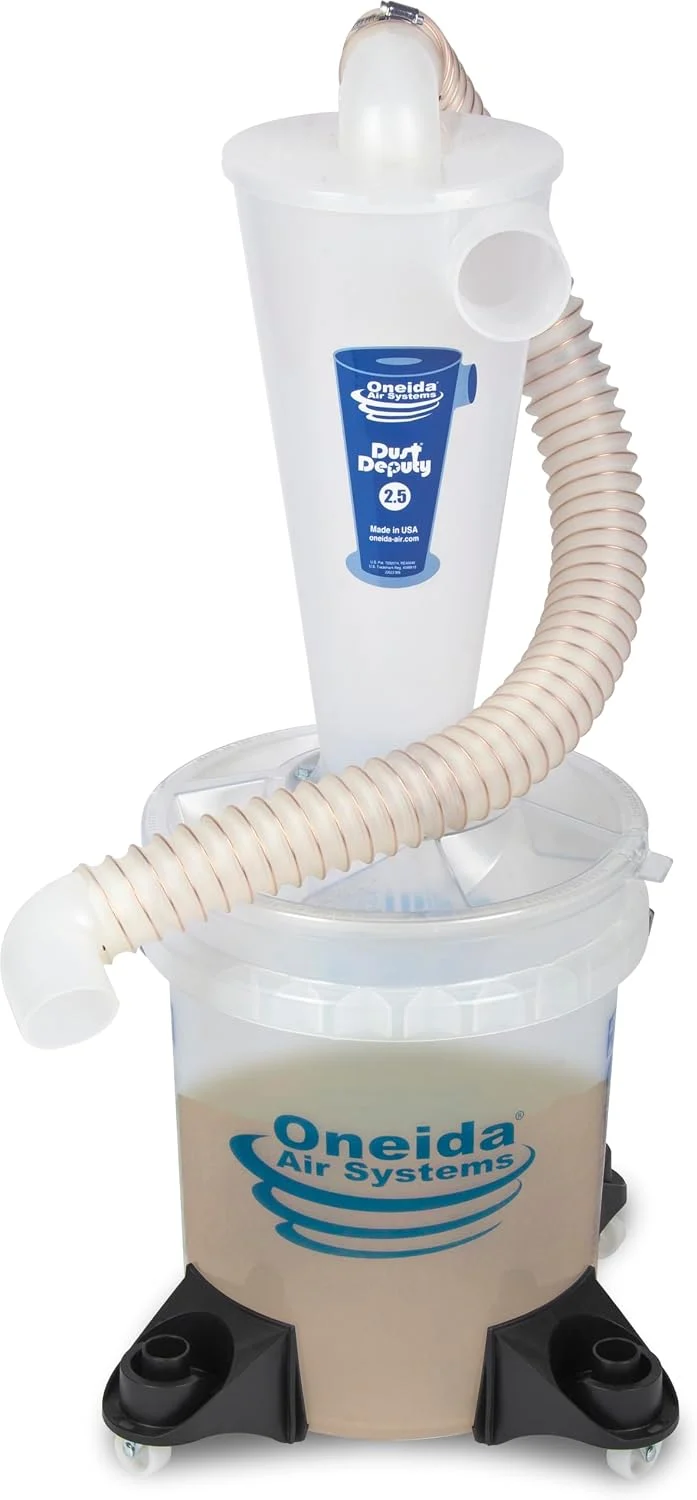
Oneida Dust Deputy 2.5 Deluxe separator kit
Traditional tall cyclone kit for a suitable shop vacuum. Verify selected kit contents, complete assembly height, and actual hose cuff fit.
Check price on Amazon for Oneida Dust Deputy 2.5 Deluxe separator kit (opens in a new tab)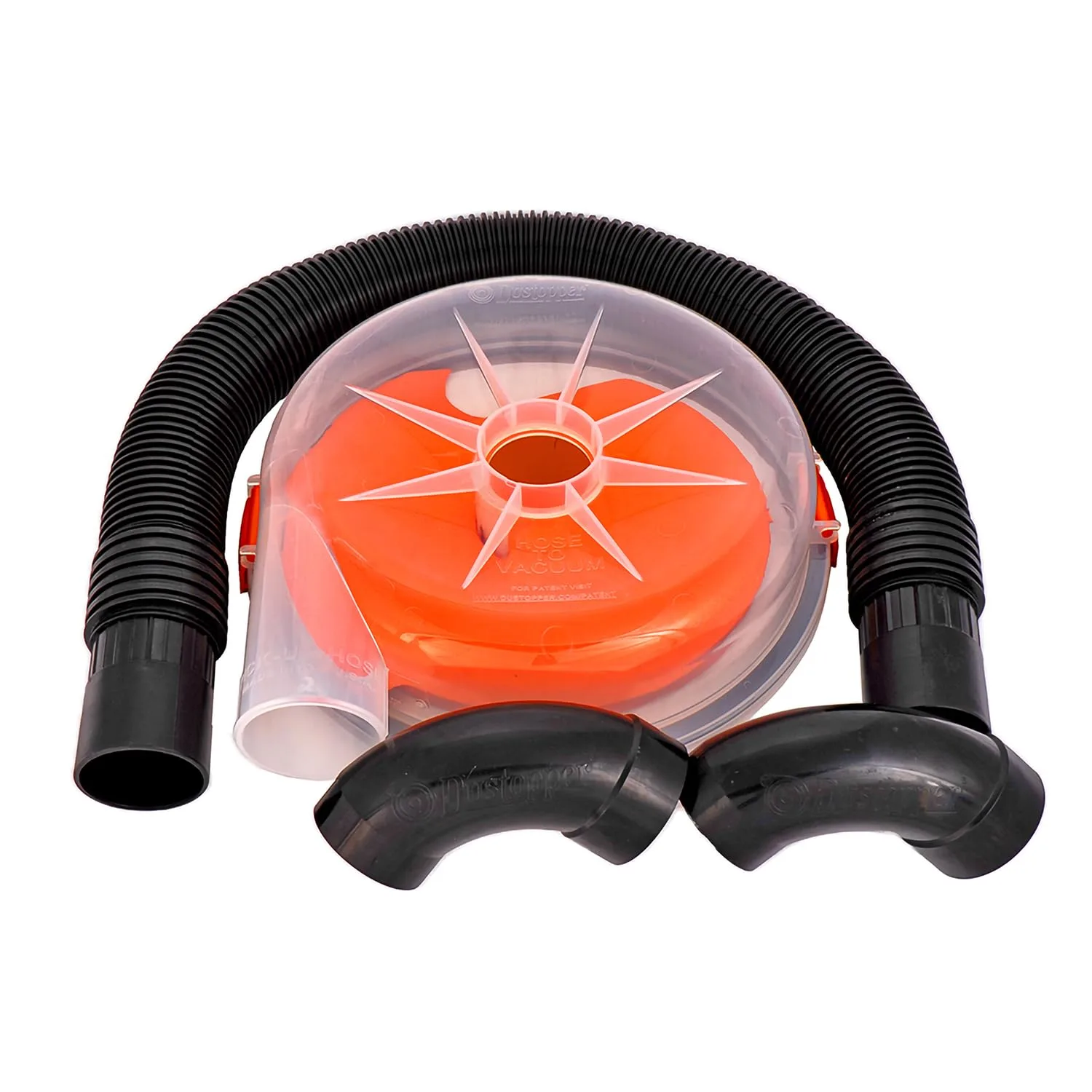
Dustopper PRO low-profile separator
Low-profile separator lid for a compatible five-gallon bucket and shop vacuum. Include the bucket, elbow clearance, and hose connections in the purchase plan.
Check price on Amazon for Dustopper PRO low-profile separator (opens in a new tab)The purchase is rarely just “cone versus lid.” You are choosing a container, hose path, emptying routine, and a place for the assembled system. Measure those first; the most efficient separator on paper is frustrating if you cannot reach its bin or fit it under your bench.
Research comparison — October 27, 2026. We checked manufacturer product information and dimensional documentation, and used matching Amazon catalog product identities. We have not run side-by-side separation, airflow, noise, or durability tests. Affiliate links may earn a commission on qualifying purchases.
Compare the assemblies you would actually buy
| Decision | Dust Deputy 2.5 | Dustopper PRO |
|---|---|---|
| Shape | Tall, traditional cyclone above a container | Shallow separator lid on a pail |
| Best reason to choose it | Flexible DIY layout or a complete cyclone kit | Under-bench and other height-limited layouts |
| Connection planning | Nominal 2.5-inch shop-vac connections; confirm cuff dimensions | Nominal 2.5-inch vacuum connections; adapters may be needed |
| Container | Depends on DIY, Deluxe, and selected capacity | Separate compatible standard five-gallon bucket |
| Extra shopping | DIY requires a bin and hose plan; kit contents vary | Bucket, support/cart if needed, and any adapters |
| Main drawback | Assembly height and hose leverage | Bucket fit and vacuum matching still need checking |
| Amazon | Dust Deputy 2.5 Deluxe ↗ | Dustopper PRO ↗ |
Oneida sells multiple configurations. The current five-gallon Deluxe manufacturer page is a specific kit, not a promise that every Amazon variation contains that kit's latest clear bucket and accessories. Check the selected ASIN's contents before ordering.
Where the Dust Deputy 2.5 makes sense
The 2.5's main appeal is a conventional cyclone layout sized for larger shop-vac connections. A DIY buyer can choose the collection vessel and cart arrangement rather than accepting a fixed bin layout. A complete-kit buyer can reduce the number of separate fittings and container decisions.
The constraint is vertical space. Oneida's dimensional drawing shows the cyclone itself at 15-5/8 inches high. That is before allowing for the container beneath it and clearance to service the assembly. Mock up the total height with cardboard, including the top hose bend, rather than measuring only the cone.
A tall separator can also give a tugged hose more leverage over its mounting and bin. Position the vacuum and separator so their connection hose is supported. Move the cart by its intended handle, not by the tool hose. An installation that works at the center of the bench should still work when you reach the far corner with a sander.
We would favor the DIY route for a permanent station where a strong airtight bin and adequate support are already planned. We would compare a complete kit for frequent relocation, provided the exact kit solves the container and stability problems you would otherwise have to build around.
Where the Dustopper PRO makes sense
The Dustopper PRO manufacturer page specifies a low-profile lid for most standard five-gallon buckets, nominal 2.5-inch connections, and two sweep elbows. Its fit advantage is easy to understand: more of the assembled height belongs to the useful collection bucket, with less occupied by a tall cone.
That can simplify a compact cart or under-bench station. It does not eliminate clearance requirements. The latches need access, the lid must lift for emptying, and the hose should not be flattened against the underside of the bench. Measure the complete assembly with the elbows fitted, including the route to the vacuum.
Dustopper recommends vacuums rated at 5 peak HP or above. Treat that as its compatibility guidance, not as an accurate continuous-power comparison between brands. A small extractor that needs reducers is a different setup from the full-size shop vac shown in product imagery. Ask the manufacturer if your vacuum is outside its stated guidance.
We would choose the PRO for a buyer who already owns a suitable bucket and vacuum and wants the assembly to stay compact. Its low body is a practical advantage, but it does not remove the need for an airtight seal or a sound container.
Do the advertised separation percentages settle the comparison?
No. Both manufacturers publish high separation claims. Those claims depend on dust type, airflow, fill level, seals, and test setup; the product pages do not give us a common independent head-to-head test.
A separator can collect a substantial pile of coarse chips while some finer material continues toward the vacuum. Checking the bin alone therefore tells you little about the final filter's condition. Inspect the vacuum filter and maintain the prescribed bag arrangement even when pre-separation looks effective.
Oneida also advertises an airflow advantage over smaller cyclones and lid-style separators. That is a manufacturer comparison under its test conditions. It does not mean your complete sander-and-hose setup will double its delivered airflow. A restrictive tool outlet can dominate the system, and extra hose still adds resistance.
Hose fit: nominal sizes are not a shopping list
Write down the outside diameter of the part that must enter a connection and the inside diameter of the part receiving it. Note any taper, locking tabs, or threaded end. “Two-and-a-half-inch” can describe a hose system without guaranteeing every cuff fits every port.
Oneida's current product specifications distinguish nominal dimensions from tapered actual dimensions, while its drawing shows a roughly 2-5/16-inch port opening. That is a good example of why a caliper and the current product drawing are more useful than rounding every connection to 2.5 inches.
For an existing vacuum, lay out this path before buying: tool → pickup hose → separator inlet → separator outlet → vacuum hose → vacuum. Count every adapter. Our shop-vac adapter guide explains how to avoid two fittings that have the same outside diameter but cannot connect.
Compare the full cost and emptying routine
Include the separator, suitable collection vessel, lid or reinforcement where needed, hose, elbows, clamps, cart materials, and adapters. A cheaper bare component can cost more as a finished station. Conversely, a complete kit adds little value if you already own every other required component.
Then plan emptying. Can you remove a full bucket without lifting the vacuum? Is there space to release each latch? Will you have to disconnect several hoses every time? A second compatible lidded bucket can make a small station easier to manage, but it should not encourage filling the working bin up to the separator discharge.
Questions buyers ask
Which would you put under a workbench?
We would begin with the Dustopper PRO, then measure the bucket, elbows, hose bends, and lid-removal space. A low separator with no emptying clearance is still a poor fit.
Will either replace a four-inch collector for a planer?
No. Match the collection system to the machine's requirements. These shop-vac separators are not substitutes for a properly sized large-port collector. Start with our dust collector sizing guide.
Can I remove the vacuum's filter after installing a separator?
No. Keep the filtration and collection arrangement specified for the vacuum and material. A pre-separator is an additional component upstream, not final filtration.
Is an anti-static body a complete grounding system?
No. Follow the exact manufacturer instructions for every component. An anti-static description is not a certification of the assembled system for combustible or hazardous dust.
Our buying choice remains a fit decision: Dustopper PRO on Amazon ↗ for low-clearance layouts, or Dust Deputy 2.5 Deluxe on Amazon ↗ when the taller kit suits the space. Read the individual Dustopper review and Dust Deputy review for configuration detail. Photographs are product catalog images, not a comparative test setup.
Explore the recommendations.
Check Amazon for current product details, available options, and pricing.
Oneida Dust Deputy 2.5 Deluxe separator kit
Product details
Traditional tall cyclone kit for a suitable shop vacuum. Verify selected kit contents, complete assembly height, and actual hose cuff fit.
- Nominal 2.5-inch shop-vac connection family
- Multiple DIY and complete-kit configurations exist
- Keep the prescribed vacuum filter and bag installed
Dustopper PRO low-profile separator
Product details
Low-profile separator lid for a compatible five-gallon bucket and shop vacuum. Include the bucket, elbow clearance, and hose connections in the purchase plan.
- Manufacturer lists nominal 2.5-inch connections
- Low-profile lid format
- Check vacuum guidance and bucket fit